
Disclosure: Some of the links on this site are affiliate links. This means that if you click on the link and purchase an item, I may receive a small commission at no extra cost to you. I only recommend products and services that I personally use, trust, or believe will provide value.

You might be here because you’re seriously exploring your career options, and one job that keeps popping up as a job that nurses actually like is PACU nursing.
But before you apply for a PACU job, I want you to know one thing: not all PACU nursing positions are the same. And no, it’s not always a walk in the park. Actually, consider reading my article on the downsides of PACU nursing too.
One of the biggest differences in PACU settings is outpatient or ambulatory surgery center PACU vs inpatient PACU.
I’ve worked in both settings, first in an ambulatory surgery center, then eventually moving to an inpatient PACU, and let me tell you, there is a pretty stark difference between the two.
Just a note: In this article, I’m comparing ASC nursing with what I would consider a standard inpatient PACU. I know there are PACUs that recover much higher acuity and more complex surgical patients, including trauma patients, pediatric oncology patients, and patients undergoing major brain or thoracic surgeries.
And honestly, even as an experienced PACU nurse, some of those cases still scare me just thinking about recovering them.
Those types of PACUs are on a completely different level and probably deserve their own article because they are definitely not a walk in the park.
ASC Nurse vs Inpatient PACU Nurse: Quick Comparison
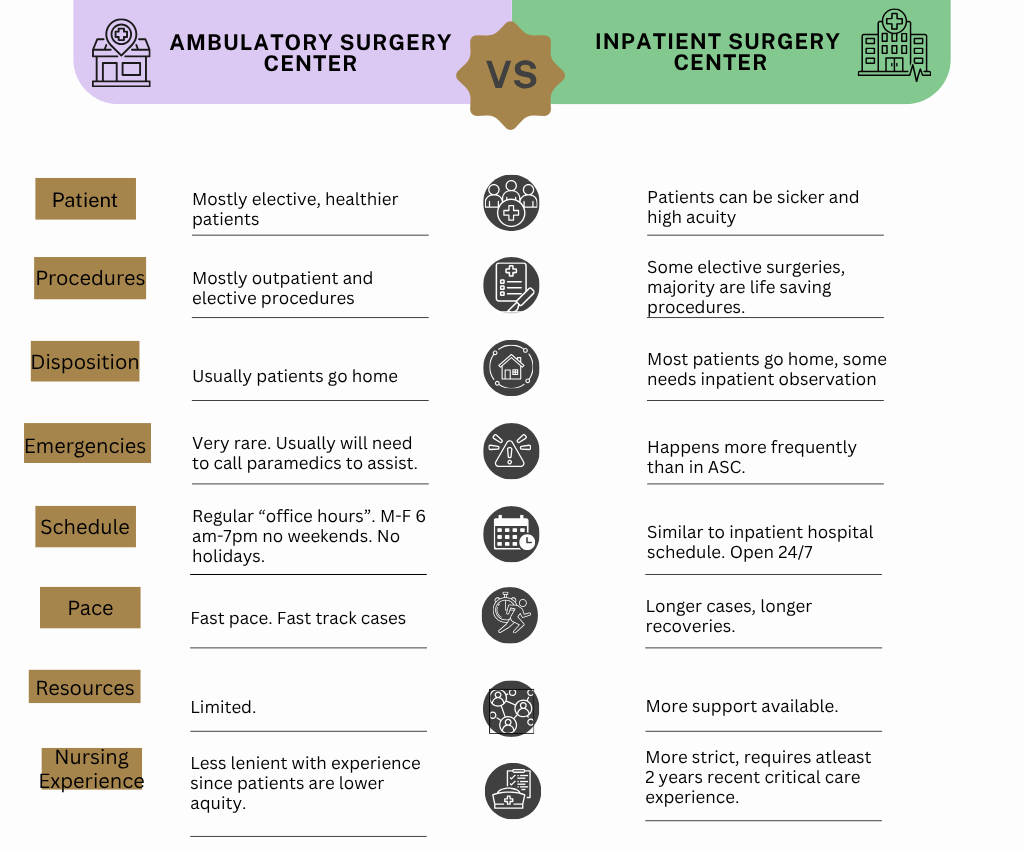
What Is an ASC Nurse?

An ASC nurse, or ambulatory surgery center nurse, is a registered nurse who works in a surgical setting designed for patients to go home the same day. This is also commonly called same day surgery or outpatient surgery.
Nurses who work in an ASC commonly work in Pre Op and PACU.
ASC Pre Op and PACU nurses basically have the same roles and responsibilities as inpatient Pre Op and PACU nurses, except most, if not all, of their patients go home after surgery.
If you’re interested in becoming an ASC nurse, read my article:
A Day in the Life of an Ambulatory Surgery Center PACU and Pre Op Nurse.
What Does an Inpatient PACU Nurse Do?

In an inpatient PACU, both Pre Op and PACU nurses basically do the same things that outpatient or ambulatory surgery center nurses do.
To learn more about what PACU nurses actually do, you can read my article on:
What Is a PACU Nurse?, including the job description and responsibilities of a PACU nurse.
But yes, basically the same roles and responsibilities, except inpatient Pre Op and PACU nurses frequently prepare and recover sicker and higher acuity patients. These are often patients who may not be safe having their surgeries or procedures performed in a smaller, less staffed or less resourced outpatient surgery center.
But don’t get me wrong. Not all the patients in the inpatient PACU where I work get admitted to the hospital after recovery. The majority still go home.
However, I would say at least 20% of our patients, because of their risk of morbidity or the type of surgery they had, usually longer and more complicated surgeries, stay overnight for observation, usually on a med surg floor and sometimes in a step down unit or even in the ICU.
The Biggest Differences Between ASC and Inpatient PACU Nursing
1. Patient Acuity

In an ambulatory surgery center, the common procedures are usually quick and relatively easy to recover from. The whole setting is designed around patients being able to safely go home after surgery.
Before the surgery center schedulers book a case, the surgeon and anesthesia team review the patient’s chart to make sure the patient can safely undergo surgery and recover in an outpatient setting.
Sometimes, even when a patient is already booked and sitting in Pre Op, the surgery can still be cancelled.
For example, if the Pre Op nurse performs an assessment and identifies a potential risk, such as a recent illness, respiratory infection, or vital signs outside of a safe range, the nurse reports it to the anesthesiologist. For the patient’s safety, the surgery may be cancelled and rescheduled until the patient is healthier.
Meanwhile, in an inpatient surgery setting, although the majority of patients may still be healthy enough to go home after recovery, some patients undergo surgery because they are already very sick.
Sometimes surgery is the only way to save their lives, such as in cases involving bleeding, infection, or another serious condition requiring urgent or emergent surgical intervention.
That alone creates a very different level of patient acuity between the two settings.
2. Types of Surgeries and Procedures

When I worked in an ambulatory surgery center, some of the most common procedures we had were simple eye cases such as cataract surgeries and smaller orthopedic or hand procedures, including carpal tunnel release and trigger finger surgery.
These cases can be very quick.
Some are what we call fast track cases.
Some cataract procedures don’t even require patients to be NPO, depending on the type and amount of anesthesia or sedation being used.
Meanwhile, with some simple orthopedic hand procedures, only local numbing medication may be used. I’ve even seen patients go to work right after.
Meanwhile, in the inpatient surgery center where I currently work, we still do some relatively simple surgical cases, but a large portion of our surgeries require at least some form of sedation, MAC, or general anesthesia.
The surgical cases can also be more complicated and much longer.
Some common cases we prepare and recover as Pre Op and PACU nurses in an inpatient surgical setting include:
Laparoscopic cholecystectomy
Mastectomy
Hysterectomy
Total joint replacement
Abdominal surgeries
Nephrectomy
And many others.
3. Patient Turnover and Pace

Is PACU Nursing Fast Paced?
I never realized how capable I was at time management and streamlining almost routine tasks until I started working as a Pre Op and PACU nurse in an ambulatory surgery setting.
Ambulatory surgery center PACU nursing is fast paced.
Just imagine working an eight hour shift, with a 30 minute lunch break and two 15 minute breaks, while caring for at least six to seven patients a day.
It is fast paced.
Sometimes as a PACU nurse, especially with patients who received only local anesthesia or very light moderate sedation, I would recover a patient for only about 30 minutes, and then my next patient would already be arriving from the OR.
Lots of Waiting in an Inpatient PACU
In the inpatient setting, though, the pace can actually be much slower.
The surgical cases are longer, so sometimes there is quite a bit of waiting for the OR to call for a PACU bed.
The majority of surgical cases where I work can take around two hours, and some take longer than six hours.
I know. Really.
Once patients arrive from the OR, especially after general anesthesia, they typically need to be recovered in PACU for at least an hour. Most of my patients take around 1½ to 2 hours to recover, sometimes longer depending on whether they develop a postoperative complication.
There are also situations where we need to admit our postoperative patient to the hospital, but there is no inpatient bed available yet.
So we hold onto those patients in PACU.
Sometimes for hours.
Personally, I typically recover around four to five patients during my 10 hour inpatient PACU shift.
4. Emergencies and Critical Care Skills

When I worked in the ambulatory surgery center, most patients were screened beforehand to make sure they were relatively healthy to safely have surgery in an outpatient setting.
So naturally, there weren’t many emergency or critical patient events happening.
But is PACU considered critical care?
Yes.
No matter what surgical setting you work in, whenever anesthesia is involved, there is still a risk for critical patient events. That’s why I think it is extremely important for PACU nurses, even those working in an outpatient setting, to have strong critical care skills.
On the inpatient surgery side, I’m not saying all of our patients are going through Code Blues or RRTs every day, lol.
I’m not even saying they happen frequently.
Our anesthesia team does a very good job managing the risks of even our high risk sick patients undergoing urgent or emergent surgeries.
But yes, our patients can be sicker, so there are more opportunities for critical events to occur in an inpatient PACU compared with an outpatient surgery setting.
Because of that, having solid critical care skills as an inpatient PACU nurse is, in my opinion, a must.
5. Staffing and Resources

Ambulatory surgery centers are usually smaller. Some are housed in standalone buildings that aren’t physically connected to a hospital.
At least, that was how my previous ASC was structured.
We didn’t have a pharmacy, laboratory, blood bank, Code Blue team, or Rapid Response Team immediately available within the facility.
If there was a patient emergency, most of our nurses and staff were ACLS and PALS certified, and we had anesthesiologists and CRNAs available who would usually help manage the critical event.
If the situation couldn’t be resolved, paramedics would be called.
Thankfully, because patients in an ASC are carefully screened to make sure they are healthy enough and low enough risk for elective outpatient surgery, these events were few and far between, if not rare.
On the other hand, inpatient surgical settings are usually connected to a hospital, so naturally, we have access to the resources of the entire hospital.
We have ICU beds if needed, pharmacy resources, STAT labs, a blood bank, radiology, Code Blue and Rapid Response Teams, and even a stroke team.
There are also more anesthesiologists and CRNAs available, and inpatient surgical settings may have internal medicine teams available when needed.
All of these resources are available by design to help safely care for higher morbidity and higher acuity patients, including those undergoing potentially lifesaving emergency surgeries.
6. Schedule and Work Life Balance

Ambulatory surgery centers usually operate somewhat like office hours, typically Monday through Friday, with operating hours that may start around 6 AM and end sometime in the evening.
Because of this, ASC Pre Op and PACU nurses typically have no weekends, no holidays, and no call, depending on the facility.
This can be perfect if you’re looking for better work life balance as a nurse.
Read why so many of my former Pre Op and PACU coworkers loved working in the ASC:
Why I Love PACU and Pre Op Nursing: Better Work Life Balance, Less Stress.
ASCs typically don’t have overnight shifts.
But we’re talking about surgery here, and surgeries can be unpredictable.
Cases run late.
When I used to work as a the late shift ASC PACU nurse, sometimes I had to wait until 8 or 9 PM for the last patient to finish surgery and then recover the patient for another hour.
Honestly, I didnt mind it because it meant an hour or two of overtime pa, and I still got to go home and sleep in my own bed.
Inpatient surgery settings operate more like hospitals because, well, they are hospitals.
It’s basically 24/7.
Naturally, inpatient Pre Op and PACU schedules are designed around hospital operations. We have full core staffing Monday through Friday, when the majority of scheduled surgeries happen, with fewer staff working evenings, overnight shifts, and weekends because there are fewer scheduled cases during those times.
Some Pre Op and PACU nurses also take call during weekends and holidays for unscheduled or emergent cases.
A few of the Pre Op and PACU nurses I work with don’t like working weekends or being on call.
Personally, I don’t really mind it.
Weekend shifts are usually pretty chill because there are fewer surgical cases, and honestly, I don’t really mind the on call money either.
7. ASC Nurse vs Hospital PACU Nurse Salary

ASC nurse and inpatient PACU nurse salaries depend heavily on several factors, including location, experience, employment status, union status, and the healthcare system you work for.
One thing I have noticed from local job postings here in Los Angeles is that some independent ambulatory surgery centers, meaning facilities that aren’t affiliated with a large hospital or healthcare system, may pay less than surgical facilities affiliated with larger healthcare systems.
In my personal experience, Pre Op and PACU nurses working within the same hospital or healthcare system are generally paid according to the same nursing pay structure.
Where you may see a difference is because of the schedule.
Inpatient Pre Op and PACU nurses may have opportunities for shift differentials, weekend differentials, overtime, and call pay, which can make a noticeable difference in overall compensation.
Which Is Better: ASC or Inpatient PACU Nursing?

This is definitely a question that can only be answered individually.
If you want to care for patients who are generally healthier, work with elective and relatively fast surgical cases, and don’t mind a very fast paced environment in exchange for a more predictable Monday through Friday schedule, then ASC Pre Op and PACU nursing might be your dream job.
If you’re comfortable caring for sicker patients, recovering patients after longer and more complicated surgeries and general anesthesia, and you want to use more of your nursing and critical care skills, then inpatient PACU nursing may be better for you.
Personally, I don’t think there is necessarily a winner between ASC vs inpatient PACU nursing.
They both have pros and cons.
But as a former ASC Pre Op and PACU nurse who eventually switched to inpatient Pre Op and PACU, I’ve actually grown to love working on the inpatient side.
Is ASC Nursing Easier Than Inpatient PACU?
I’ll answer this directly and honestly.
Personally, I think ASC Pre Op and PACU nursing is much easier than inpatient Pre Op and PACU nursing.
Aside from the fast pace and rapid turnover, which was manageable for me, the obvious difference is that patients at an ASC are generally healthier, easier to prep and recover, and their surgical cases tend to be less complicated therefore less post op complications.
I used to joke with another PACU nurse that I almost lost my nursing skills after working nearly six years as an ASC Pre Op and PACU nurse.
The ASC workflow is designed around getting the patient admitted to the surgery center, having the procedure, recovering safely, and going home the same day.
I’m saying this in general terms but I know there are some ASCs that perform more complicated surgeries that traditionally would have been performed in an inpatient surgical setting.
Once I moved to inpatient PACU, I had to almost relearn a lot of my nursing skills. I even had to brush up on some of my old ICU and critical care knowledge so I could work efficiently as an inpatient Pre Op and PACU nurse.
Can You Move From ASC PACU to Inpatient PACU?

Of course.
This is the exact path I took, although in my opinion, going the other way is probably easier, lol.
Ambulatory surgery center PACU is still PACU nursing, even though there are differences in workflow and, obviously, patient acuity.
If you’re planning to transition from ASC PACU to inpatient PACU, just keep in mind that there will probably be a learning curve. There may be more responsibilities and more tasks simply because there is more involved when preparing and recovering a sicker, higher acuity patient.
That’s also why I think many nurses eventually transition in the opposite direction, from inpatient PACU to ASC Pre Op and PACU nursing, when they’re looking for a lighter nursing workload.
My Experience Transitioning as an ASC PACU Nurse to Inpatient PACU Nurse
Honestly, after working as an ASC Pre Op and PACU nurse for almost six years, I mourned my move to the inpatient side.
I loved working as an ASC Pre Op and PACU nurse because even though it was very fast paced, it was the first time in my nursing career where I somehow never really felt rushed. Lol.
The patients were rarely very sick, and you got to watch them go home in stable condition, which was a vastly different experience from when I used to work in the ICU.
It almost felt like lighthearted nursing.
In all honesty, it was probably the easiest type of nursing I had ever done.
But eventually, life happens, and I had to make the switch to inpatient PACU.
For a while, I was scared.
I suddenly felt incompetent caring for sicker and higher acuity patients after becoming so used to healthier ASC patients.
But after about a year and a half working in inpatient Pre Op and PACU, I finally feel like I’m getting past that relearning curve, and I’m actually glad I made the switch.
I have a better schedule now. Honestly, I couldn’t stand the eight hour shifts in the ASC. They were too short, which meant I had to work more days.
To each their own, though, because I know plenty of nurses, especially nurses with kids, who prefer eight hour shifts.
I also feel like working inpatient has forced me to learn more again, and surprisingly, it has made me want to keep learning. I’m even planning to take my CPAN certification.
And, of course, I definitely welcome the slower pace of the inpatient PACU setting.
Final Thoughts: ASC vs Inpatient PACU
Neither PACU setting is necessarily better or worse than the other.
They simply appeal to different types of nurses and different priorities.
You might prefer a predictable schedule, healthier patients, elective surgeries, and rapid turnover. Or you might prefer a more variable schedule, higher acuity patients, using more of your critical care nursing skills, and maybe even getting some of that on call pay.
My transition from ASC Pre Op and PACU nursing to inpatient PACU nursing proved to me that I probably shouldn’t judge a nursing job at first glance.
I genuinely thought I was going to hate my new inpatient PACU job.
Instead, I actually ended up loving it.
And now I’m hoping this is where I’ll eventually retire as a PACU nurse.
Did this article make you want to apply for a PACU nursing job?
If yes, get a step ahead and read my article about: