Disclosure: Some of the links on this site are affiliate links. This means that if you click on the link and purchase an item, I may receive a small commission at no extra cost to you. I only recommend products and services that I personally use, trust, or believe will provide value.
What Is a PACU Nurse?
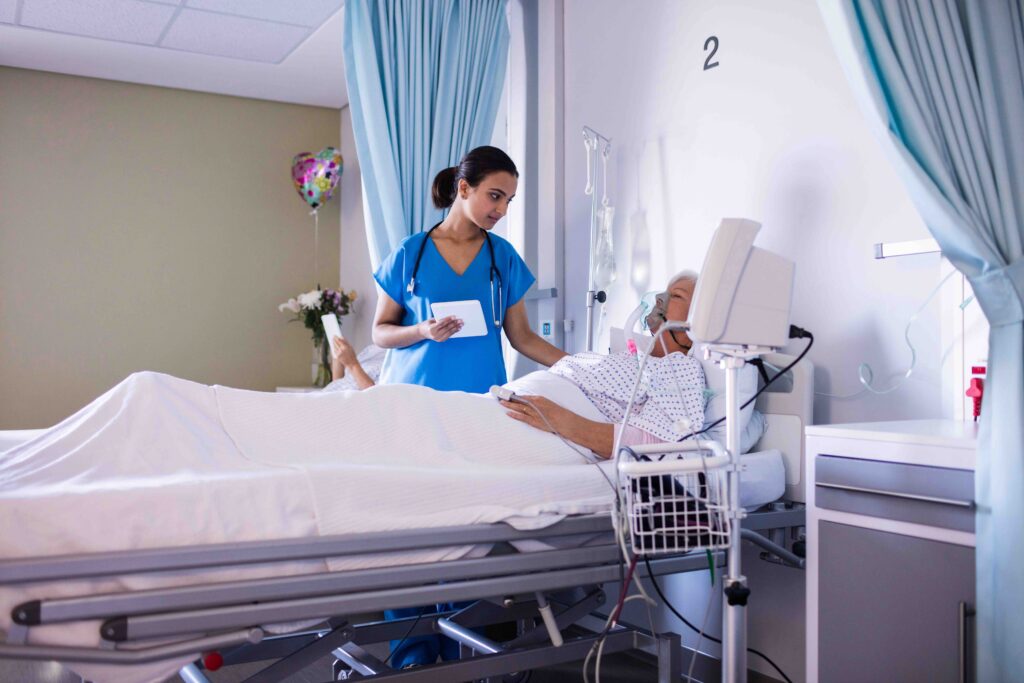
A PACU nurse is a Registered Nurse who specializes in caring for patients as they recover from anesthesia after surgery or a medical procedure.
We PACU nurses are trained to monitor patients for airway obstruction, respiratory depression, unstable vital signs, bleeding, cardiac arrhythmias, hypotension, uncontrolled pain, nausea, and other complications that can happen after surgery.
Our job is to recognize these problems early, intervene quickly, and make sure patients recover safely before going home or transferring to another unit.
Simply put, our goal is to keep patients safe during one of the most vulnerable parts of their surgical journey: waking up from anesthesia.
I’ve been working as a PACU nurse since 2018, first in an outpatient ambulatory surgery center and now in a hospital-based inpatient PACU. In this guide, I’ll explain what PACU nurses actually do, what a typical shift looks like, the skills you’ll need, salary expectations, and whether PACU nursing might be the right specialty for you.
A PACU nurse can work in several different healthcare settings, including:
- Hospital based PACU’s
- Ambulatory surgery centers (ASCs)
- Outpatient surgery centers
- GI or endoscopy centers
- Cardiac catheterization (Cath) labs
- Pain management centers
- Plastic surgery clinics
Depending on where you work, you may also rotate between Pre Op and PACU, preparing patients for surgery before recovering them afterward. That’s exactly how I’ve spent most of my career, and honestly, I enjoy getting to see both sides of the patient’s surgical journey.
What Does PACU Stand For?
PACU stands for Post Anesthesia Care Unit. It’s a specialized area in a hospital or surgical facility where patients recover immediately after receiving anesthesia for a surgical or medical procedure.
You’ll also hear people call it the Recovery Room. Honestly, they’re basically the same thing. Recovery room is the older, more commonly used term, while PACU sounds a little more formal and is what most hospitals use today.
What Does a PACU Nurse Do?
As a PACU nurse for the past 6 years, working in both outpatient surgery centers and an inpatient hospital PACU, I’ve found that many parts of the job become second nature. Every patient and every surgery is different, but the overall goal is always the same: help patients recover safely from anesthesia and surgery while watching closely for any signs of complications.
On a typical shift, some of my responsibilities include:
- Preparing to receive my patient from the operating room (OR). In the inpatient setting, I usually have time to quickly review the patient’s chart before they arrive. In a fast paced ambulatory surgery center, though, patients come out one after another, so there’s often very little time for chart review.
- Connecting the patient to the bedside monitor and closely monitoring their heart rate, heart rhythm, blood pressure, oxygen saturation, and respirations. Most patients require vital signs every 15 minutes for at least the first hour, although this can vary depending on their condition.
- Assessing pain and treating post anesthesia symptoms such as nausea, vomiting, shivering, or elevated blood pressure. Our goal is to make sure patients are comfortable while also keeping them safe.
- Monitoring the surgical site for bleeding, excessive drainage, or other early signs of complications.
- Providing discharge instructions to both the patient and, preferably, their responsible adult. Let’s be honest, if you’ve just woken up from anesthesia and received IV pain medication, you probably won’t remember half of what I just told you.
- Helping patients prepare for discharge, including assisting them with getting dressed if needed.
- Giving report to the receiving nurse if the patient is being admitted to the hospital for further observation or continued care.
One thing that surprised me when I first became a PACU nurse is that our job isn’t just monitoring patients while they wake up. We have to constantly anticipate what could go wrong next and recognize subtle changes before they become emergencies. Sometimes that means giving a little more pain medication. Other times, it means recognizing the early signs of internal bleeding, respiratory depression, or an unstable heart rhythm and getting the anesthesia provider or surgeon involved immediately.
Also Read: What Is PACU? A PACU Nurse Explains the Recovery Room

PACU Nurse Job Description
The primary task of a PACU nurse is to ensure the safety of the postoperative patient as they recover from anesthesia and surgery.
First and foremost, we secure and maintain the patient’s airway and make sure they are oxygenating adequately, with or without supplemental oxygen. We closely monitor vital signs and intervene when necessary to maintain or stabilize the patient’s condition.
We also manage postoperative pain and other symptoms, with the goal of bringing pain down to zero when possible or to a level that is tolerable for the patient.
Finally, we make sure the patient meets the appropriate recovery criteria for a safe discharge home or transfer to another unit.
PACU Nurse Responsibilities
Aside from the hands on tasks we perform every day, being a PACU nurse comes with a tremendous amount of responsibility. Our job isn’t just to monitor patients after surgery. It’s to keep them safe during one of the most critical phases of their recovery while using sound clinical judgment to recognize problems before they become emergencies.
Some of our biggest responsibilities include:
- Protecting the patient’s airway while they recover from anesthesia.
- Recognizing early signs of deterioration, such as respiratory depression, excessive bleeding, unstable vital signs, or abnormal heart rhythms.
- Managing pain and other post anesthesia symptoms while ensuring medications are given safely.
- Communicating changes in the patient’s condition to the anesthesia provider, surgeon, charge nurse, and other members of the healthcare team.
- Accurately documenting assessments, medications, interventions, and the patient’s response to treatment.
- Providing discharge education to patients and their responsible adult so they understand how to safely recover at home.
- Advocating for the patient, even when it means delaying discharge if you believe it’s unsafe.
For me, patient advocacy is one of the most important responsibilities of a PACU nurse.
I remember caring for an elderly patient who had recently fallen at home and fractured her elbow. After surgery, she recovered well in PACU and eventually met all of our usual discharge criteria.
Before I started reviewing her discharge instructions, I casually asked who would be staying with her once she got home.
She looked at me and said, “Oh, I’ll be home by myself.”
Immediately, my nurse alarm bells started going off.
Here’s an elderly patient who had just fallen at home, underwent surgery, was still recovering from anesthesia, and would likely be taking narcotic pain medication. Sending her home alone didn’t feel safe.
Even though she technically met the discharge criteria, I wasn’t comfortable with the plan.
So I spoke with the anesthesia provider, surgeon, and my charge nurse about my concerns.
Instead of going home, the patient was admitted to the medical surgical unit for further observation.
Later, I heard that Social Services became involved to help ensure she had a safe discharge plan.
That experience reminded me that being a PACU nurse isn’t just about checking boxes on a discharge checklist. Sometimes our biggest responsibility is speaking up when something doesn’t feel right.
One of the best pieces of nursing advice I’ve ever received was:
“Treat the patient, not the monitor.”
Vital signs and discharge criteria are important, but they don’t replace clinical judgment. If your gut is telling you something isn’t right, slow down, reassess your patient, and don’t be afraid to advocate for them.
That’s what being a PACU nurse is all about.
How the PACU Nurse Role Changes Depending on Where You Work
A PACU nurse’s job description can vary depending on the patient, the type of surgery, and where you work. A PACU nurse in an outpatient or ambulatory surgery center may have different responsibilities than one working in a hospital based PACU, but our overall goal is always the same: to safely recover patients from anesthesia and surgery.
For example, in an outpatient surgery center, much of our job focuses on preparing patients to go home the same day. We provide discharge instructions, make sure pain and nausea are controlled, and confirm that patients meet all discharge criteria before they leave with a responsible adult.
In a hospital based PACU, we often recover patients after larger or more complex surgeries. Some patients go home, while others are admitted to a medical surgical, telemetry, or intensive care unit. In these situations, our job is to stabilize the patient, continue close monitoring, and give a thorough handoff report to the receiving nurse.
Working on the Weekends as a PACU and Pre Op Nurse
The job can even change depending on the day of the week.
For example, on weekends where I currently work, only a handful of nurses are scheduled. We often don’t have a unit clerk, nursing assistant, or transporter available, so PACU nurses end up wearing several hats.
On those days, I may find myself:
- Processing admission paperwork that would normally be completed by the unit clerk.
- Coordinating patient flow with the Operating Room charge nurse.
- Preparing patients in Pre Op before surgery.
- Recovering those same patients in PACU after their procedure.
- Transporting patients when transport staff aren’t available.
It definitely keeps the day go by faster when you wear different hats.
No matter where you work, though, the core PACU nurse job description stays the same.
Our primary responsibilities are to:
- Receive patients from the operating room.
- Assess and monitor their recovery from anesthesia.
- Recognize and treat post operative complications.
- Manage pain, nausea, and other post anesthesia symptoms.
- Communicate with surgeons, anesthesia providers, and other healthcare team members.
- Ensure patients are safe for discharge home or transfer to another unit.
While those responsibilities sound straightforward on paper, no two patients are ever the same. One patient may wake up smiling and asking for a snack, while the next may require rapid intervention for airway obstruction, uncontrolled pain, severe hypertension, unexpected bleeding or just screaming and yelling due to emergence delirum. That’s one of the things I enjoy most about PACU nursing. Every day is different, and you never really know what’s coming through the OR doors next.
Daily Duties of a PACU Nurse
Every shift starts a little differently, but my routine is usually the same.
The first thing I do when I arrive is look at our assignment board to see whether I’m working as the Pre Op nurse or the PACU nurse that day. Let’s say I’m assigned to PACU.
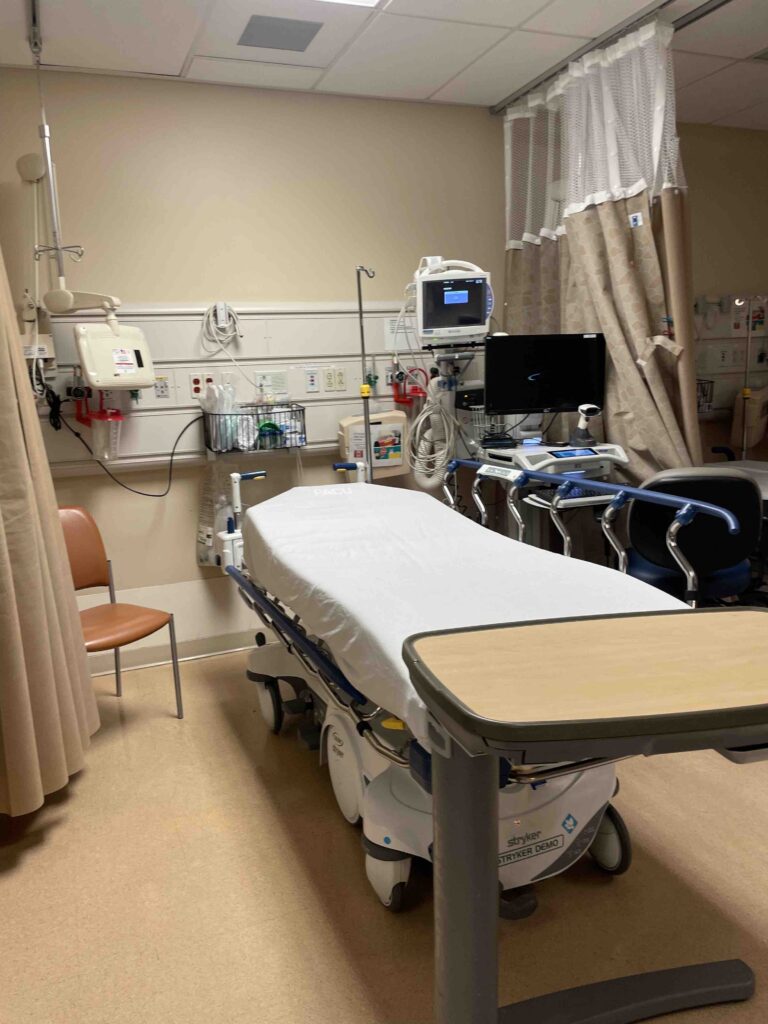
I head to my recovery bay, which usually consists of two side by side patient bays with a computer workstation in the middle. Before my first patient arrives, I make sure everything is ready to go.
I check that I have all my supplies, including:
- Scavenger hunt for a Thermometer (because somehow its always disappearing in PACU 😂)
- Oxygen masks, nasal cannulas and other airway devices
- Gauze and Coban
- PureWick and other supplies ready when needed
- Working wall suction
- Warm blankets and the Bair Hugger
After that, I grab my work phone, log into the computer, and make sure everything is working properly.
Trust me, always check your computer first.
I learned that lesson the hard way. One time I received a fresh post operative patient, and just as I was about to start charting, my computer decided it was the perfect time for a system reboot. I couldn’t chart anything and ended up moving my patient to another bay. Lesson learned.
Once my patient arrives from the operating room, things start moving quickly.
I connect them to the bedside monitor, make sure their oxygen is connected to the wall oxygen instead of the portable tank, turn on the Bair Hugger if they’re cold, and receive handoff from both the OR nurse and the anesthesia provider.
During report, I pay close attention to details such as:
- The surgical procedure performed
- Any complications during surgery
- Medications given
- The type of surgical dressing or adhesive used
- Special post operative instructions
Some patients leave the operating room wearing abdominal binders or specialized dressings that shouldn’t be removed for several days, so it’s important to know exactly what was done before I begin my assessment.
Once report is complete, I perform my initial assessment.
My priorities are always the ABCs, especially making sure the patient’s airway is open and they’re breathing adequately. I also inspect the surgical site for bleeding, review my PACU orders, and check whether IV fluids need to be replaced.
If the patient is having pain, I’ll administer the appropriate pain medication, which is commonly IV Fentanyl where I work. If they’re nauseated, I’ll treat that as well. If their blood pressure remains consistently above or below our parameters after repeated vital signs, I’ll notify anesthesia for additional orders.
While my patient is resting comfortably, I try to stay one step ahead.
I’ll call the patient’s family or responsible adult to let them know surgery is finished and remind them to pick up any prescribed medications on their way back. Those few minutes often make the discharge process much smoother later.
Throughout recovery, I continue monitoring vital signs every 15 minutes during Phase I recovery, then every 30 minutes once the patient is stable and progressing toward discharge.
When it’s time to go home, I review the discharge instructions with both the patient and, preferably, their responsible adult. Patients are often still feeling the effects of anesthesia, so I always want another set of ears listening.
If the patient is being admitted instead of discharged, I give a detailed handoff report to the receiving nurse before arranging transport to the appropriate unit.
Finally, I help the patient get dressed if needed, remove their IV, and make sure they’re ready to leave safely.
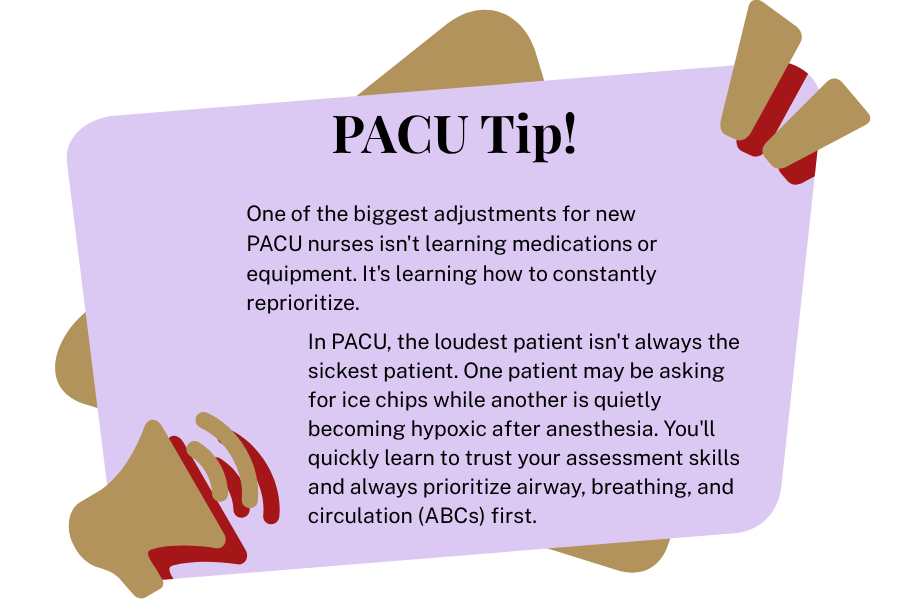
One thing many people don’t realize is that I’m usually doing all of this while caring for another patient at the same time. In California, PACU nurses typically care for up to two Phase I recovery patients simultaneously, so learning how to prioritize and safely juggle both patients is one of the biggest skills you’ll develop in PACU.
Some days are calm and uneventful. Other days, one patient is peacefully sleeping while the other is waking up confused, nauseated, hypertensive, and trying to climb out of bed. That’s PACU nursing for you. Every day keeps you on your toes.
Also Read: Day in the Life of a PACU Nurse in an Amubulatory Surgery Center
Essential PACU Nurse Skills
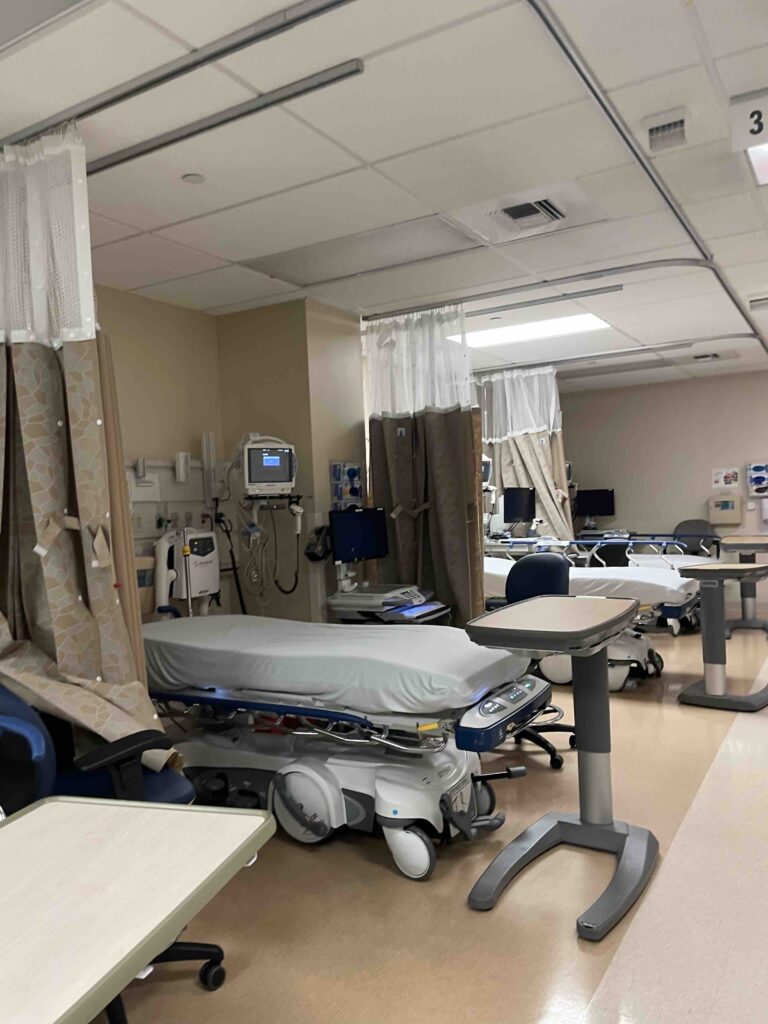
Aside from understanding your responsibilities, becoming a successful PACU nurse also requires developing a unique set of clinical, technical, and interpersonal skills. Some of these you’ll learn during orientation, while others only come with experience and seeing the same situations over and over again.
These are the skills I believe every PACU nurse should develop.
Clinical Skills:
Airway Management
If there’s one skill every PACU nurse should be confident in, it’s airway management.
Patients recovering from anesthesia are at risk for airway obstruction and respiratory depression. As a PACU nurse, you’ll learn how to quickly recognize airway compromise and perform simple interventions such as a head tilt, chin lift, or jaw thrust while waiting for additional help if needed.
Protecting your patient’s airway will always be your first priority.
Cardiac Rhythm Recognition
You’ll spend a lot of time looking at cardiac monitors.
A good PACU nurse can quickly recognize when a patient’s heart rhythm changes from their baseline and identify potentially life threatening arrhythmias that require immediate intervention.
You don’t have to become a cardiologist, but you should feel comfortable recognizing when something just doesn’t look right then call the cardiologist! lol
Pain Management
One of our biggest responsibilities is helping patients wake up comfortably after surgery.
No, this doesn’t mean becoming a drug dealer. 😂
It means learning how to safely administer pain medications while finding the right balance between keeping patients comfortable without over-sedating them.
You’ll also learn to recognize the signs of Opioid-Induced Respiratory Depression (OIRD) and understand when enough pain medication is enough.
Sometimes giving less medication is actually the safer decision.
Assessment Skills
PACU nurses become really good at spotting subtle changes.
Sometimes the first sign that something is wrong isn’t the blood pressure or heart rate.
It’s how the patient looks.
A slight change in skin color.
A patient becoming harder to wake up.
An abdominal distention that wasnt there prior to surgery.
Good assessment skills allow you to recognize these small changes before they become major problems.
IV Medication Administration
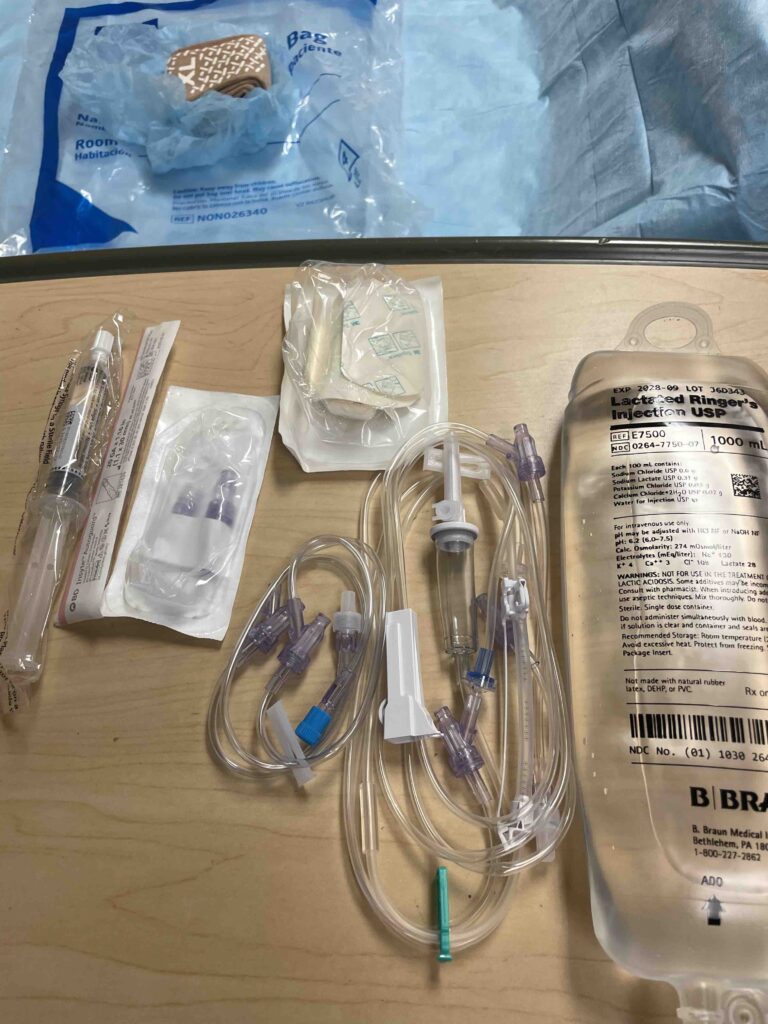
Depending on where you work, you may administer a variety of IV medications throughout your shift.
Occasionally, you’ll even have to start a new IV because the original one infiltrated during surgery.
You’ll also become comfortable using IV infusion pumps, especially if you work in a hospital based PACU where medications such as antibiotics, antihypertensives, or blood transfusions are sometimes needed.
Soft Skills
Communication
PACU nurses communicate with almost everyone.
- Pre Op nurses
- OR nurses
- Anesthesia providers
- Surgeons
- Respiratory therapists
- Floor nurses
- Patients
- Family members
- Sometimes even transport/ambulance crews and even Uber drivers lol
Good communication keeps patients safe and helps prevent important information from being missed during handoffs.
Staying Calm Under Pressure
Some patients wake up smiling.
Others wake up screaming in pain.
Others wake up confused and trying to climb out of bed.
As a PACU nurse, you’ll learn to stay calm even when everything around you feels chaotic. Your patient is looking to you for reassurance, so remaining calm helps everyone else stay calm too.
Prioritization
This is probably one of the hardest skills to learn.
Imagine this situation.
Patient A has just had their airway removed and their oxygen saturation is dropping into the low 80s.
Patient B is awake and repeatedly calling because they need to use the restroom.
Who do you see first?
The answer is always Patient A.
In PACU, you’ll quickly learn that the loudest patient isn’t always the sickest patient.
Always prioritize your ABCs: Airway, Breathing, and Circulation and learn to ask or even Yell for Help!
Critical Thinking
Monitors are helpful, but they don’t replace nursing judgment.
A good PACU nurse constantly asks,
“Does this make sense?”
If something doesn’t look right, trust your assessment, investigate further, and don’t hesitate to call for help when needed. Thats the good thing about working in PACU, there will always be someone to ask help from.
Empathy
Surgery can be one of the most stressful experiences in a person’s life.
A little reassurance, a warm blanket, and simply telling a patient, “You’re doing great. Surgery is over,” can make a huge difference.
Sometimes that’s just as therapeutic as the medications we give.
Patient Education
Never assume patients will remember everything you tell them immediately after anesthesia.
Whenever possible, include the patient’s responsible adult during discharge teaching. They’re usually the one who’ll remember the instructions once everyone gets home.
Technical Skills
Electronic Charting
You’ll spend a surprising amount of your day documenting.
Become comfortable navigating your hospital’s electronic health record and documenting accurately, thoroughly, and efficiently.
On some shifts, especially weekends, you may even find yourself performing tasks that are normally handled by the unit clerk.
IV Infusion Pumps
Probably one of the banes of my existence.
Just when I finally learn how to use one IV pump, the hospital decides it’s time to upgrade to a completely different model.
When I moved from an ambulatory surgery center to an inpatient PACU, I had to relearn infusion pumps because now I have to routinely administer medications such as Zosyn and Vancomycin and sometimes blood products, all of which require an IV pump.
It’s one of those skills that gets easier with practice.
Arterial Line (A-Line) Setup
You won’t see arterial lines every day, but when you do, you should know how to set them up correctly.
I’ll be honest.
Even after years in PACU, whenever I receive a patient with an A-line, I still sometimes ask one of my coworkers to double check my setup.
And you know what?
There’s absolutely nothing wrong with asking for help.
Patient safety will always be more important than pretending you know everything.
A Typical PACU Nurse Workflow
One of the biggest misconceptions about PACU nursing is that we simply wait for patients to wake up after surgery.
In reality, every patient follows a fairly structured recovery process, and as a PACU nurse, I’m constantly assessing, treating, and preparing for the next step.
This is what a typical PACU workflow looks like.
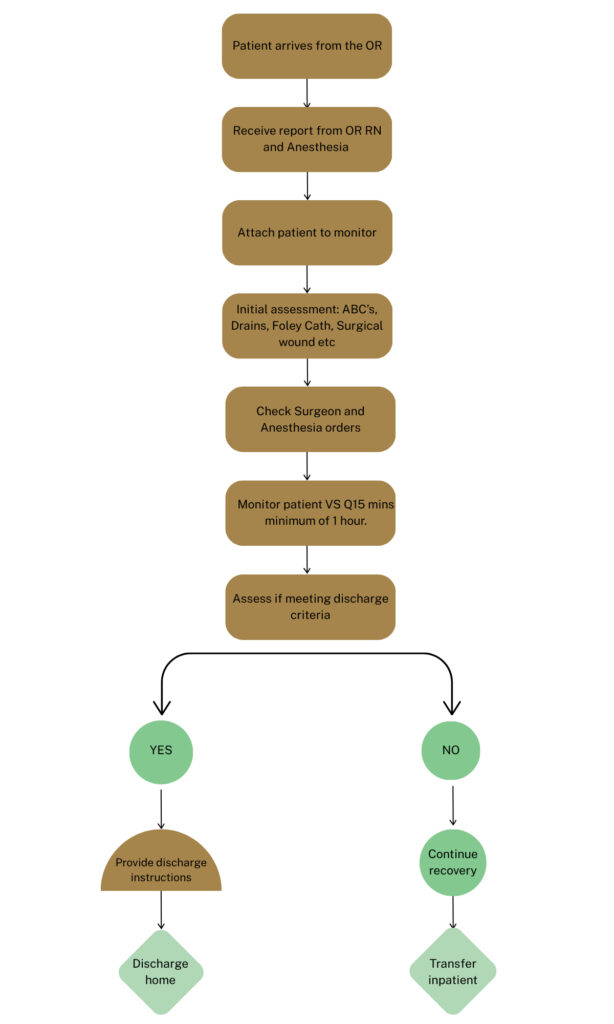
Step 1: Receive the Patient from the Operating Room
Every patient arrives in PACU with both the OR nurse and anesthesia provider.
Before anything else, I receive a detailed handoff report, including:
- The surgical procedure performed
- Medical history
- Allergies
- Medications given during surgery
- Estimated blood loss
- Any complications during the procedure
- Special post operative instructions
This report helps me anticipate what problems I should be watching for during recovery.
Step 2: Initial Assessment
As soon as report is finished, my assessment begins.
My priorities are always the ABCs.
- Airway
- Breathing
- Circulation
I connect the patient to the monitor, assess their airway, check their oxygen saturation, inspect the surgical site, evaluate their level of consciousness, and obtain my initial set of vital signs.
Step 3: Manage Pain and Post Anesthesia Symptoms
Once I know the patient is stable, I focus on making them comfortable.
Depending on the patient’s needs, this may include treating:
- Pain
- Nausea or vomiting
- Shivering
- High blood pressure
- Low oxygen levels
- Anxiety or emergence delirium
Every patient wakes up differently, so there’s no “one size fits all” approach.
Step 4: Continuous Monitoring
The next phase is close observation.
Throughout recovery, I continue monitoring:
- Vital signs
- Oxygen saturation
- Pain level
- Surgical dressing
- Drainage or bleeding
- Level of consciousness
- Overall recovery from anesthesia
This is also when I’m updating family members, documenting my assessments, and preparing for discharge or transfer.
Step 5: Determine Discharge Readiness
Before a patient leaves PACU, I make sure they meet our discharge criteria.
This generally includes:
- Stable vital signs
- Adequate pain control
- Minimal nausea
- Alert enough to follow instructions
- No significant bleeding
- Able to safely transfer or ambulate if appropriate
If something doesn’t look right, the patient stays in PACU longer or is admitted for further observation.
Step 6: Discharge Home or Transfer to Another Unit
The final step depends on the patient’s condition.
Patients having outpatient procedures usually go home with a responsible adult after receiving discharge instructions.
Patients requiring additional monitoring are transferred to another unit, such as Medical Surgical, Telemetry, ICU, or another appropriate level of care.
Once that patient leaves, I clean and prepare my bay because chances are my next patient is already coming out of the OR.
Although every hospital has slightly different recovery protocols, the overall PACU workflow is remarkably similar whether you work in an outpatient surgery center or a hospital based PACU.And then…we do it all over again.
What Is a Typical PACU Nurse Schedule?
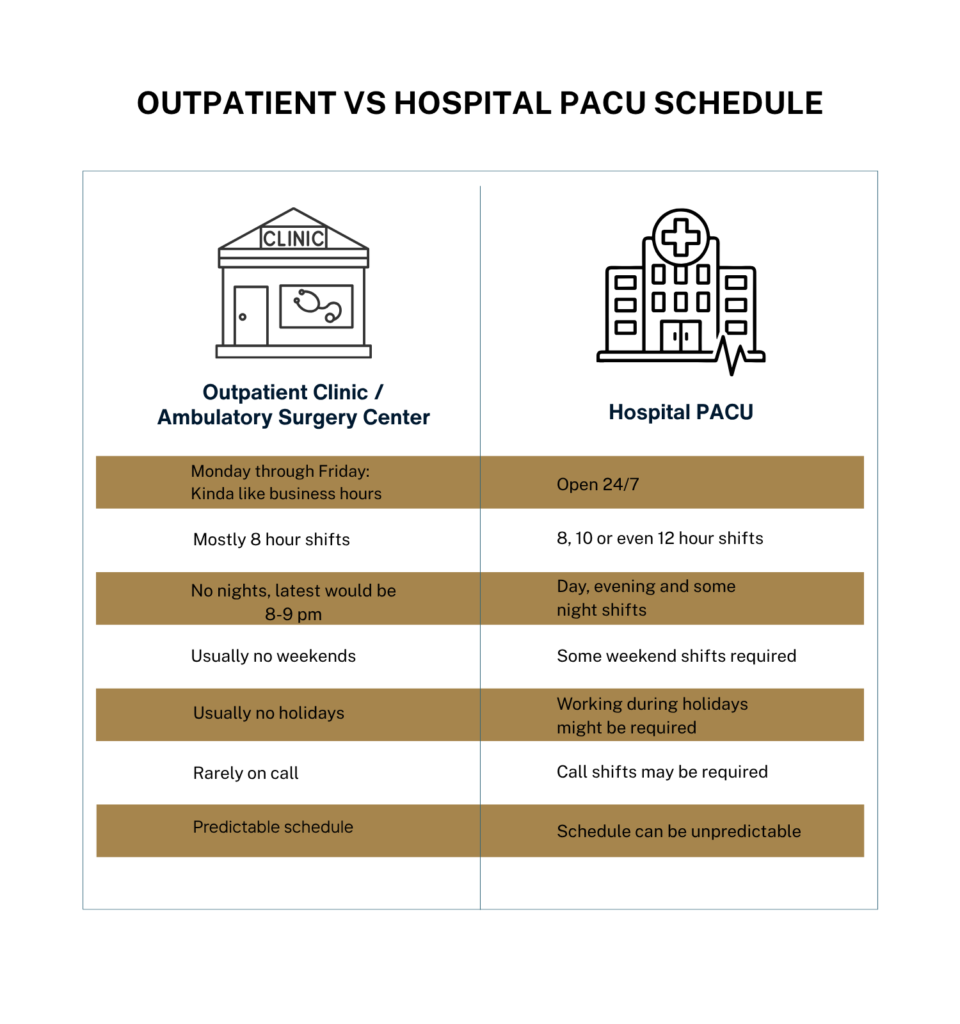
One of the things I love most about PACU nursing is that there isn’t just one schedule. Your hours can look completely different depending on whether you work in an outpatient surgery center or a hospital based PACU.
I’ve worked in both settings, and while the job itself is very similar, the schedules are quite different.
Outpatient Surgery Centers (Ambulatory Surgery Centers)
Most outpatient surgery centers, pain management clinics, endoscopy centers, vascular clinics, and plastic surgery centers operate during regular business hours.
That means PACU nurses in these settings usually enjoy a much more predictable schedule.
Typical hours include:
- Monday through Friday
- 8 hour shifts (the most common)
- Some 10 hour shifts
- Very few 12 hour shifts
- No overnight shifts
- Closed on most weekends and holidays
This is one of the biggest reasons many experienced nurses eventually transition from the hospital to an ambulatory surgery center.
My Experience
When I worked as a Pre Op and PACU nurse in an ambulatory surgery center, I usually worked 8 hour per diem shifts from 8:30 AM to 4:00 PM.
If I was assigned to Pre Op, I’d occasionally start as early as 5:30 AM because our first surgical cases typically began around 7:00 AM, and patients needed to be prepared at least an hour beforehand.
When I worked as the closing PACU nurse, I’d start later in the day and stay until the last patient had recovered and been discharged home. Some evenings that meant staying until around 8:00 PM before we closed the surgery center.
I honestly loved the predictability of the schedule. It almost felt like having an office job…except your office happened to be a recovery room. 😂
Hospital Based PACU
Hospital based PACUs are a little different.
Even though many of the surgeries are elective and scheduled, hospitals operate 24 hours a day, 7 days a week.
Emergency surgeries don’t stop just because it’s nighttime, a weekend, or a holiday.
Because of that, hospital PACU nurses may work:
- 8 hour shifts
- 10 hour shifts (the most common where I work)
- 12 hour shifts
- Day shift
- Evening shift
- Night shift
- Weekend shifts
- Holiday shifts
- Call shifts, depending on the hospital
Night shifts are usually much quieter because most scheduled surgeries have already finished. The patients coming through PACU overnight are often emergency surgical cases, and there are nights when no surgeries happen at all.
My Current Schedule
I currently work two 10 hour shifts a week as a part time PACU nurse in a hospital based surgery center.
Honestly, moving from an ambulatory surgery center to an inpatient PACU came with a bit of a learning curve. I had to get comfortable with IV pumps again, relearn a few hospital workflows, and occasionally care for higher acuity patients.
But looking back, it was one of the best career decisions I’ve made.
I traded my 8 hour per diem schedule for a benefited part time position, and having health insurance, retirement benefits, and a more flexible work life balance has been well worth it.
Sometimes taking a small step backward in one area helps you move forward in several others.
Now that we’ve covered what PACU nurses do and what their schedules look like, let’s talk about where PACU nurses can actually work. You might be surprised by how many different settings hire PACU nurses.
Where Do PACU Nurses Work?
Many people assume PACU nurses only work in hospitals, but that’s not true. PACU and Pre Op nurses can work in a variety of healthcare settings that perform surgical or procedural cases requiring anesthesia or sedation.
Some of the most common places you’ll find PACU nurses include:
- Hospital based surgery centers that perform both elective and emergency surgeries.
- Ambulatory Surgery Centers (ASCs) or outpatient surgery centers.
- GI and endoscopy centers.
- Cardiac catheterization (Cath) labs.
- Pain management clinics.
- Vascular surgery centers.
- Plastic and cosmetic surgery centers.
- Fertility clinics.
- Ophthalmology surgery centers.
- Orthopedic surgery centers.
- ENT surgery centerrs.
Depending on the facility, you may work exclusively in PACU, or you may rotate between Pre Op and PACU, just like I have throughout most of my career.
One of the things I enjoy most about working in an ambulatory surgery center was getting to prepare my patients before surgery and then recover those same patients afterward. It gave me a better understanding of their entire surgical journey instead of only seeing one part of it.
Hospital based PACUs are a little different. While some nurses work only in PACU, others may float to Pre Op, Phase II Recovery, or occasionally assist in other perioperative areas depending on staffing needs.
No matter where you work, the goal remains the same: provide safe, high quality care while helping patients recover from anesthesia and preparing them for discharge or transfer.
My Personal PACU Nurse Salary Progression
One of the questions I get asked the most is:
“How much do PACU nurses make?”
The honest answer is…it depends.
Your salary will vary based on where you live, whether you work in a hospital or an ambulatory surgery center, your years of experience, and whether your workplace is unionized.
Rather than giving you a national average, I thought it would be more helpful to share my own PACU salary progression here in Los Angeles, California.
Of course, your experience may look very different depending on where you work.
2018: My First PACU Job
In 2018, I landed my first PACU job as a per diem Pre Op and PACU nurse at an ambulatory surgery center in Los Angeles, California.
At the time, I already had about five years of acute care experience, including Oncology, Telemetry, Step Down, and ICU nursing.
I was hired as a Level II Registered Nurse with a starting hourly rate of $65 per hour.
At the time, I thought that was amazing. Little did I know what was coming over the next several years.
2021: Taking a Break
In 2021, I resigned from my per diem PACU position to focus on my fertility treatments.
It wasn’t an easy decision, but sometimes life comes before work.
Thankfully, nursing is one of those careers where it’s often possible to step away for a while and come back when you’re ready.
2023: Returning to PACU
When I returned to the exact same ambulatory surgery center in early 2023, my starting rate had increased to $80 per hour.
A couple of months later, thanks to a new union bargaining agreement, my hourly wage jumped again to approximately $92 per hour.
Let’s just say…I’m a big fan of strong nursing unions. 😂
2025: Choosing Benefits Over Hourly Pay
In 2025, I made a decision that surprised a lot of people.
I left my higher paying per diem job and accepted a part time PACU position at a hospital based surgery center.
My hourly rate actually decreased to around $77 per hour.
On paper, it looked like I had taken a pay cut.
In reality, I gained something much more valuable.
I now had:
- Health insurance
- A pension
- Paid time off
- Retirement benefits
- More predictable scheduling
Sometimes the highest hourly rate isn’t always the best financial decision.
2026: Union Raises
Like many unionized hospitals, our wages continue to increase through negotiated contracts.
By the time I’m writing this article in 2026, my hourly rate has increased again at $86/hr, and another contractual raise is already scheduled later this year.
One of the biggest financial lessons I’ve learned as a nurse is that steady annual raises can have a much bigger impact than constantly changing jobs chasing slightly higher hourly pay.
My Biggest Takeaway
Looking back, my PACU salary has nearly doubled since I started in 2018.
But what’s changed even more is how I think about money.
When I was younger, I focused almost entirely on hourly pay.
Today, I think about the entire compensation package:
- Benefits
- Retirement
- Pension
- Paid time off
- Schedule
- Commute
- Work life balance
Those things have become just as valuable to me as my hourly wage.
Especially now that I’m a mom, I’d happily choose a job that gives me more time with my family over one that simply pays a few dollars more an hour.
How to Become a PACU Nurse (My Personal Pathway)
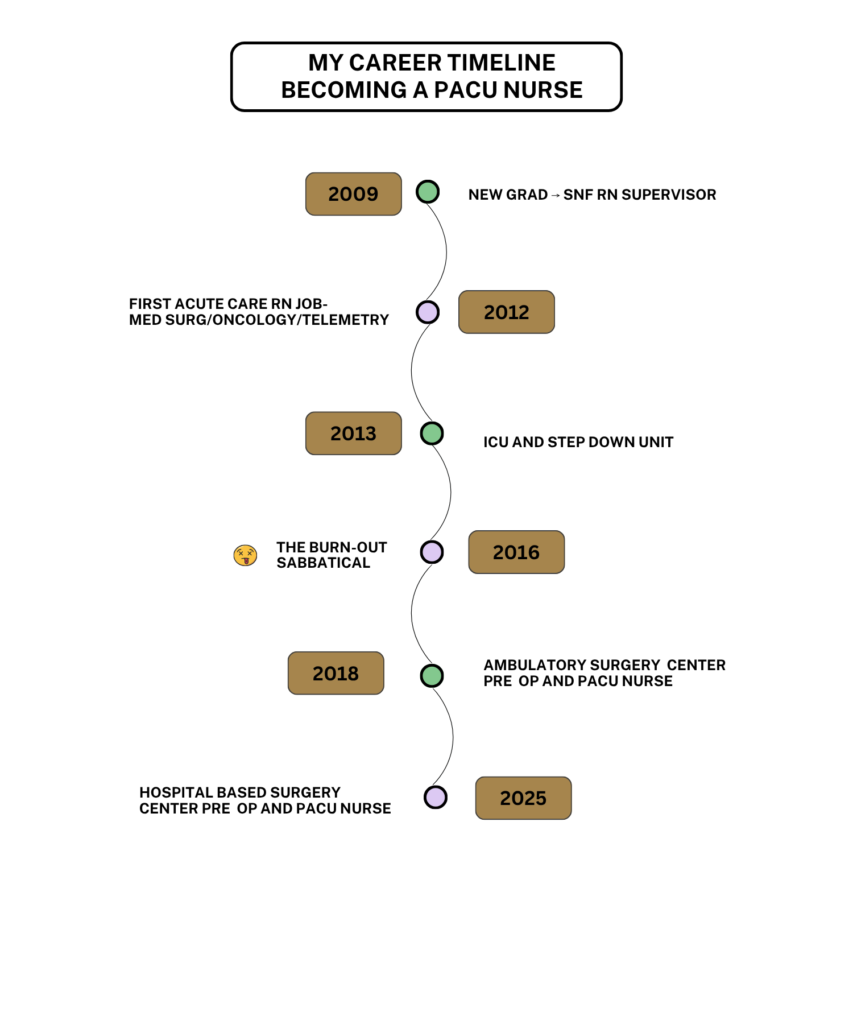
Everyone’s path to becoming a PACU nurse is a little different, so I can only share what worked for me.
I actually started my nursing career in the Philippines before moving to the United States. After passing the NCLEX, I entered the job market during the Great Recession in 2009, when even hospitals had hiring freezes.
Like many new graduate nurses at the time, I couldn’t get a hospital job right away.
So I started where I could.
A Skilled Nursing Facility (SNF).
Looking back, I know some people see SNFs as a stepping stone, but I’m honestly grateful for that experience because it gave me a solid foundation and allowed me to begin my nursing career instead of waiting around for the “perfect” job.
Step 1: Gain Acute Care Experience
After a few years, the nursing job market improved, and I was finally able to move into an acute care hospital.
I started in Oncology before floating to Telemetry.
Looking back, I think my telemetry experience played a huge role in preparing me for PACU nursing.
As a PACU nurse, you’ll spend a lot of time monitoring cardiac rhythms, recognizing changes in vital signs, and identifying early signs of patient deterioration. Those are all skills I first developed while working on a telemetry unit.
Step 2: Learn Critical Care
While working in Oncology and Telemetry, I was always impressed by the ICU nurses whenever we had a Rapid Response Team (RRT) or Code Blue.
They walked into the room looking calm, confident, and completely in control.
I remember thinking,
“I want to be that nurse someday.”
So I signed up for an ACLS course, applied to the ICU, and eventually landed a position.
Because I didn’t have previous ICU experience, my hospital provided an extensive critical care training program.
Free education while getting paid? That’s one of my favorite combinations.
I spent the next couple of years working in ICU and Step Down, where I learned skills that I still use every day as a PACU nurse.
Step 3: Burnout Changed My Direction
Then…
I crashed and burned.
ICU nursing taught me so much, but eventually the emotional and physical demands caught up with me.
I took a break from nursing for several months and honestly worried that stepping away would make it difficult to find another job.
So I applied everywhere.
I cast a very wide net.
Thankfully, one of those applications led me to an ambulatory surgery center looking for a Pre Op and PACU nurse.
That opportunity completely changed my career.
Step 4: Finding PACU
I accepted the position and immediately fell in love with PACU nursing.
It gave me everything I enjoyed about critical care, without the constant long term emotional stress that I personally experienced in the ICU.
I still use my assessment skills.
I still care for patients recovering from complex surgeries.
I still have to think critically and react quickly when something changes.
But I also get to see patients recover, smile, and go home to their families.
For me, that has made all the difference.
The rest, as they say, is history. 😊
Can You Become a PACU Nurse Without ICU Experience?
One of the most common questions I get is whether ICU experience is required.
The answer is…
It depends on the employer.
Many hospitals prefer candidates with ICU, Emergency Department, or other critical care experience, especially for Phase I PACU.
However, that’s not the only path.
Some employers hire nurses from:
- Telemetry
- Progressive Care Units (PCU)
- Step Down Units
And every now and then, a hospital may offer a PACU Nurse Residency Program for new graduates.
Those opportunities are uncommon, but they do exist.
If you’re deciding between PACU and another specialty, especially ICU, let’s compare what it’s actually like working in both environments.
Read: Difference between PACU and ICU
I also wrote something about: The Downsides of PACU Nursing here if you want to read about it.
Even though I genuinely believe it’s one of the best nursing jobs out there (yes, I’m a little biased 😂), there are definitely things I love about it and a few things that still drive me crazy.
What I Love About PACU Nursing
Some of my favorite things about working as a PACU nurse include:
- Seeing patients recover and go home after surgery.
- Using critical care skills without the long term emotional burden I experienced in the ICU.
- Caring for a wide variety of surgical patients, which keeps every day interesting.
- Working closely with anesthesia providers, surgeons, and the OR team.
- Excellent work life balance, especially in many outpatient surgery centers.
- Competitive pay and strong benefits, particularly in unionized hospitals.
No two shifts are exactly alike, and that’s one of the reasons I still enjoy coming to work.
The Downsides of PACU Nursing
Of course, PACU has its challenges too.
Some of the biggest ones include:
- Patients can deteriorate very quickly.
- The pace can be extremely busy, especially when several operating rooms are finishing cases at the same time.
- Managing two recovering patients at once requires excellent prioritization.
- Call shifts, weekends, and holidays may be required in hospital based PACUs.
- Patients don’t always wake up happy. Some wake up confused, combative, nauseated, or in severe pain.
My Honest Opinion
After working in Oncology, Telemetry, ICU, and now PACU, I can honestly say that PACU has been my favorite nursing specialty.
Is it perfect?
No.
Do I still have stressful days?
Absolutely.
But compared with where I was emotionally during my ICU years, I genuinely look forward to going to work most days.
That’s something I never thought I’d say again.
Is PACU Nursing Right for You?
Even though I absolutely love being a PACU nurse and genuinely believe it’s one of the best nursing jobs out there, it’s not for everyone.
PACU nursing has a very unique workflow compared to other nursing specialties. You’re constantly admitting new patients, recovering them from anesthesia, discharging them home or transferring them to another unit, and then doing it all over again.
If you enjoy variety, you’ll probably love it.
If you prefer caring for the same patient throughout your shift, PACU may not be the best fit.
In my opinion, you’ll probably thrive as a PACU nurse if you enjoy:
- A fast paced work environment
- Caring for a variety of surgical patients
- Using critical thinking and assessment skills
- Working closely with anesthesia providers, surgeons, and the OR team
- Seeing patients recover quickly and go home
- Learning about different surgical procedures
- Thinking on your feet when a patient suddenly deteriorates
One of my favorite parts of PACU nursing is that every day feels a little different.
During a typical 8 to 10 hour shift, I may care for six to eight different patients, although only one or two at a time during Phase I recovery. Every patient has a different surgery, different medical history, and different recovery experience, so the day never becomes repetitive.
On the other hand, PACU nursing might not be the best fit if you prefer:
- Building long term relationships with your patients
- A slower, more predictable workflow
- Managing the same patient throughout an entire shift
- Working independently rather than as part of a highly collaborative surgical team
There’s absolutely nothing wrong with that.
Every nursing specialty attracts different personalities, and that’s one of the things I love about nursing. There’s truly something for everyone.
My Personal Thoughts
If you had told me back when I was working in Oncology or ICU that I’d eventually fall in love with PACU nursing, I honestly wouldn’t have believed you.
In fact, before I became a PACU nurse, I barely knew what PACU was.
I just knew that patients came from there.
Now, I honestly can’t imagine doing anything else.
PACU gave me the chance to continue using my critical care skills while giving me a healthier work life balance and helping me rediscover why I became a nurse in the first place.
For me, it has been the perfect fit.
Maybe it’ll be yours too.
My Final Thoughts About Being a PACU Nurse
PACU nursing completely changed my career.
It reminded me that nursing doesn’t have to mean constant burnout, endless stress, or counting down the hours until your shift is over.
There are still difficult days. There are still emergencies. There are still patients who keep me on my toes.
But there are also plenty of days when I drive home thinking,
“I actually had a really good day at work.”
As nurses, I think that’s something worth striving for.
Frequently Asked Questions About PACU Nursing
What is a PACU nurse?
A PACU (Post Anesthesia Care Unit) nurse is a Registered Nurse who specializes in caring for patients recovering from anesthesia after surgery or certain medical procedures. A PACU nurse monitors the patient’s airway, breathing, vital signs, pain, nausea, and overall recovery before they’re safely discharged home or transferred to another unit.
What does a PACU nurse do?
A PACU nurse receives patients directly from the operating room, performs frequent assessments, manages pain and nausea, monitors for post operative complications, provides discharge teaching, and ensures patients recover safely from anesthesia.
Depending on where you work, you may also rotate between Pre Op and PACU, caring for patients before and after surgery.
Is PACU nursing stressful?
I don’t think there’s a single nursing specialty that’s completely free of stress.
That said, the level of stress varies depending on where you work.
If I had to rate the specialties I’ve personally worked in, it’d probably look something like this:
- PACU: 3/10
- ICU: 10/10
- Telemetry: 9/10
- Oncology: 11/10 😂
Of course, that’s just my personal experience.
Your stress level will also depend on your coworkers, your hospital, patient population, staffing, and your own personality.
Generally speaking, I’ve found PACU to be a much more relaxed environment than inpatient nursing, even though emergencies can still happen.
Is PACU nursing hard?
Yes…and no.
Like any specialty, PACU has a learning curve.
If you’re willing to learn, work well with a team, and stay calm under pressure, I honestly think most experienced nurses can become excellent PACU nurses.
Where people tend to struggle is adjusting to the fast pace and constantly changing patient assignments. If you enjoy routine and caring for the same patient all day, PACU might not be the best fit.
Is PACU easier than ICU?
For me personally, yes.
I still use many of the assessment and critical thinking skills I learned in the ICU, but I generally find PACU to be less emotionally draining.
Most of my patients recover and either go home or transfer to another unit within a few hours. In the ICU, I often cared for the same critically ill patients for days or even weeks.
That doesn’t mean PACU is “easy.” Patients can still deteriorate rapidly, and PACU nurses must be prepared to respond quickly.
Also Read: PACU Nurse vs ICU Nurse
Can new graduate nurses work in PACU?
Generally, no.
Most hospitals prefer nurses with one to two years of critical care experience, such as ICU, Emergency Department, or Step Down.
That said, there are exceptions.
Some hospitals offer PACU Nurse Residency Programs specifically designed for new graduate nurses. These programs are relatively uncommon but do exist.
How many patients does a PACU nurse have?
This depends on the phase of recovery and your state’s staffing regulations.
Here in California, PACU nurses typically care for:
- Phase I Recovery: Up to 2 patients
- Phase II Recovery: Up to 4 patients
Patient assignments may differ depending on your state, employer, and the patient’s condition
What certifications do PACU nurses need?
The most commonly required certifications include:
- BLS (Basic Life Support)
- ACLS (Advanced Cardiovascular Life Support)
Some employers, especially those caring for pediatric patients, also require:
- PALS (Pediatric Advanced Life Support)
Additional certifications that can strengthen your resume include:
- CPAN (Certified Post Anesthesia Nurse)
- CAPA (Certified Ambulatory Perianesthesia Nurse)
- CCRN, particularly if you’re transitioning from critical care
Do PACU nurses start IVs?
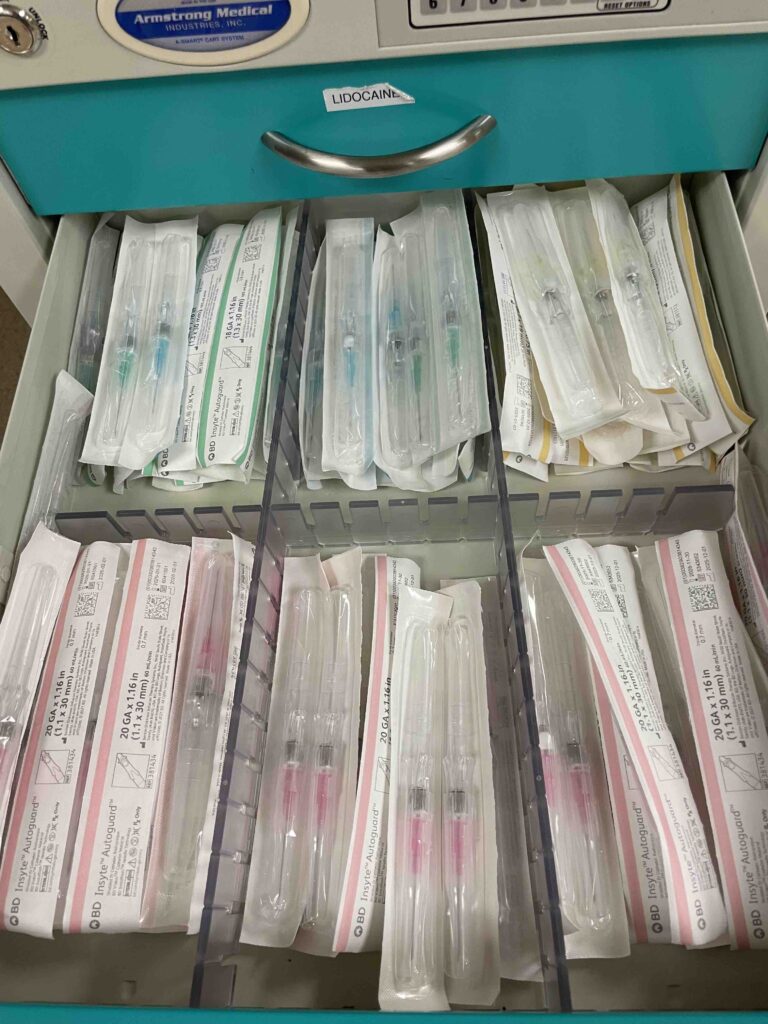
Sometimes, but probably not as often as people think.
Most patients already arrive in PACU with a functioning IV that was started in Pre Op.
Occasionally, we may need to start a new IV if the original infiltrates or stops working.
Ironically, I almost lost my IV skills because I spent so much time in PACU. 😂 Thankfully, I also work in Pre Op, so I still get plenty of practice starting IVs.
What’s the difference between PACU and the recovery room?
Honestly…
They’re the same thing.
PACU (Post Anesthesia Care Unit) is simply the more formal medical term for what many people still call the Recovery Room.
Most hospitals today use the term PACU, but you’ll still hear both names used interchangeably.
What’s the difference between PACU and Pre Op?
Think of it this way:
Pre Op prepares patients before surgery.
PACU cares for patients after surgery.
As a Pre Op nurse, you’ll prepare patients for anesthesia by starting IVs, completing assessments, administering medications, and making sure they’re ready for the operating room.
As a PACU nurse, you’ll recover patients after anesthesia, monitor their recovery, manage pain and nausea, and prepare them for discharge or transfer.
Is PACU considered critical care?
Yes, although it depends on who you ask.
PACU is considered a critical care area because patients are recovering from anesthesia, which is one of the most physiologically vulnerable periods after surgery.
PACU nurses must be prepared to:
- Protect the patient’s airway
- Recognize respiratory depression
- Manage unstable vital signs
- Identify postoperative bleeding
- Recognize cardiac arrhythmias
- Respond quickly to emergencies
Although many patients recover uneventfully, things can change very quickly. That’s why many hospitals prefer PACU nurses to have previous critical care experience.
How long do patients stay in PACU?
Most patients stay in PACU for about one to three hours, depending on:
- The type of surgery
- The type of anesthesia used
- Pain control
- Nausea
- Overall recovery
Patients having minor outpatient procedures may go home sooner, while those recovering from major surgery or experiencing complications may stay longer before being transferred to another unit.
What is the hardest part of being a PACU nurse?
For me, it’s learning to constantly reprioritize.
You’re often caring for two recovering patients at the same time, and both may need your attention.
One patient might be asking for water, while the other is quietly becoming hypoxic after anesthesia.
One of the biggest lessons I’ve learned is this:
The loudest patient isn’t always the sickest patient.
Always go back to your ABCs: Airway, Breathing, and Circulation.
Ready to Learn More About PACU Nursing?
If you’re considering a career in PACU or simply want to learn more about what it’s really like behind the recovery room doors, here are a few articles I think you’ll enjoy:
Resources:
Opiod Induced Respiratory Depression in PACU (Post Anesthesia Care Unit) https://pmc.ncbi.nlm.nih.gov/articles/PMC7982067/