Disclosure: Some of the links on this site are affiliate links. This means that if you click on the link and purchase an item, I may receive a small commission at no extra cost to you. I only recommend products and services that I personally use, trust, or believe will provide value.

Why Phase I and Phase II PACU Can Be Confusing
Starting as a PACU nurse can feel like entering a completely different world, with unfamiliar terms, routines, and everything else. But don’t fret! It’s really not that bad. You’ll learn along the way, and I promise, PACU nursing isn’t going to chew you up and spit you out (like what ICU nursing did to me, lol). You might actually enjoy it!
Even as an experienced PACU nurse, having worked in both an ambulatory surgery center (ASC) and an inpatient PACU, it took me a while to fully understand what Phase I and Phase II in PACU actually meant.
But yeah, if you’re an aspiring PACU nurse or a new PACU nurse, be prepared to hear these two important terms a lot. Familiarize yourself with them because you’re going to hear about them frequently throughout your PACU nursing career.
Are you interested in becoming a PACU Nurse if so, these related articles might be a good read for you:
What Is PACU? A PACU Nurse Explains the Recovery Room
What Is a PACU Nurse? Duties, Skills, Salary & Career Guide (2026)
What Are the Phases of PACU Recovery?
Recovery from anesthesia happens in stages. Patients don’t just wake up, change their clothes, and leave. (Well, sometimes they do, especially when general anesthesia isn’t involved!)
But for the most part, patients recovering from general anesthesia or monitored anesthesia care (MAC) go through different stages of recovery depending on their condition.
These stages are determined by several factors, including:
- Airway and respiratory status, including oxygen requirements
- Vital signs, such as blood pressure and heart rate
- Level of consciousness and drowsiness
- Pain level
- Severity of other symptoms, such as nausea and dizziness
- Ability to get up and ambulate safely
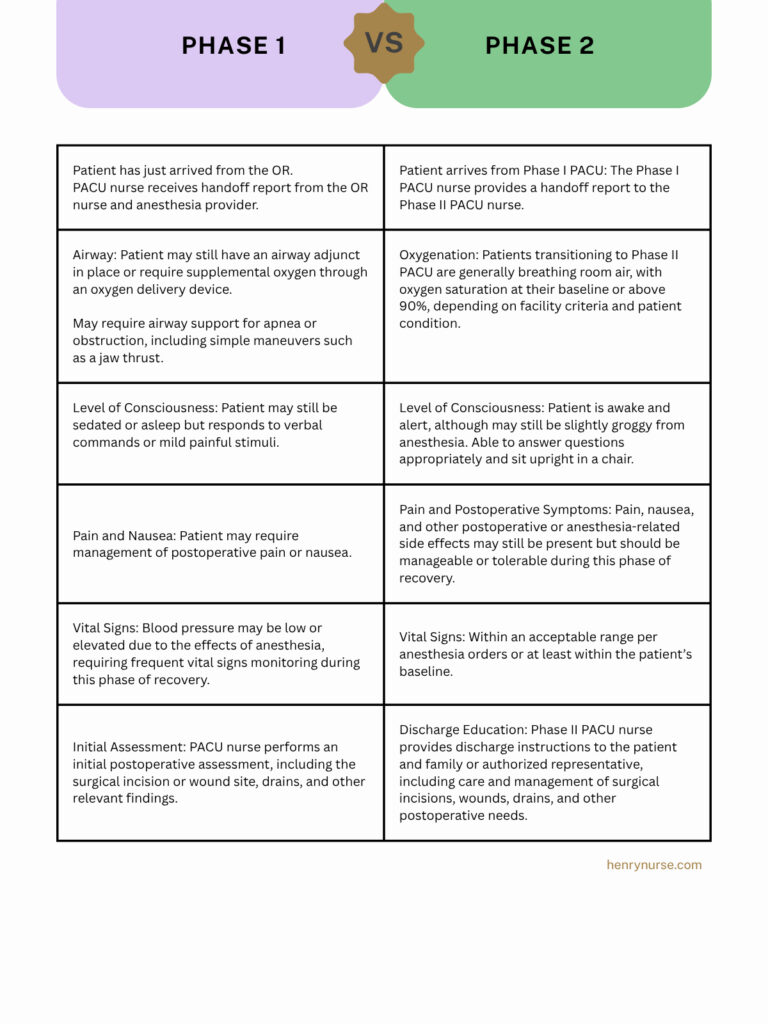
In brief, here’s what the two phases of post anesthesia care generally look like:
What Is Phase I PACU?
Phase I PACU is the immediate recovery period following anesthesia, when the focus is on physiologic stabilization. Therefore, patients in this phase generally require closer monitoring and more frequent assessments.
This is usually when patients are brought directly from the operating room (OR) into a PACU bay.
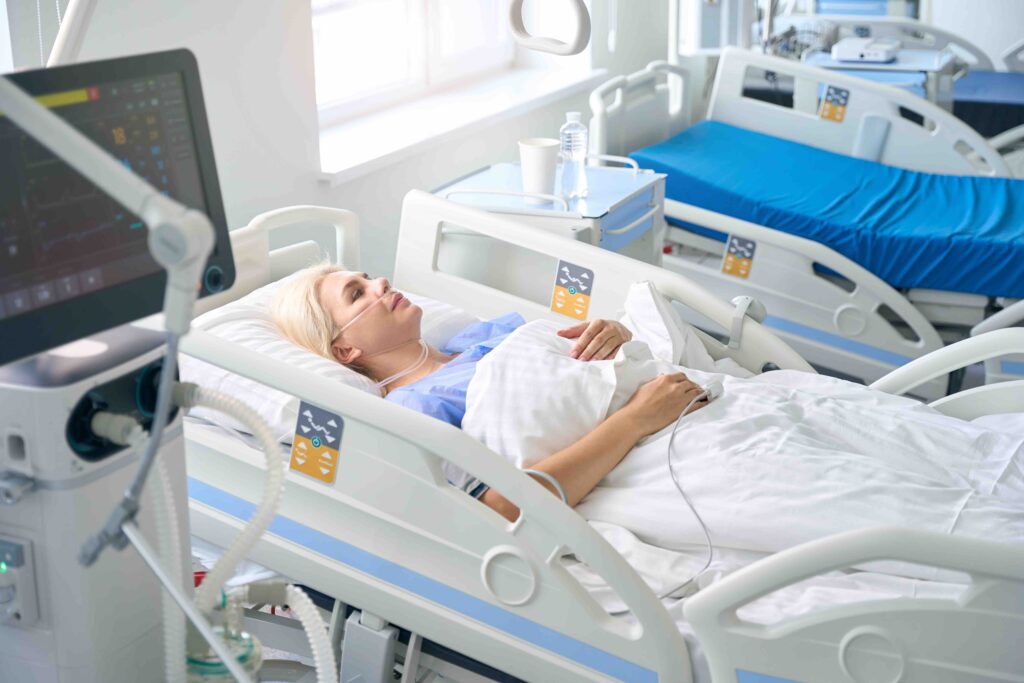
Most patients in Phase I may still be:
- Receiving supplemental oxygen through a face mask, sometimes at 6 L/min or more, depending on their respiratory needs.
- With an airway adjunct still in place to help maintain a patent airway and prevent airway obstruction.
- Heavily sedated or asleep, sometimes responding only to verbal or physical stimulation.
- Experiencing pain, nausea, or postoperative shivering.
- Experiencing blood pressure changes, including hypotension or hypertension.
During this phase of recovery, patients require a higher level of nursing assessment, monitoring, and intervention.
As a Phase I PACU nurse, your priority is to recognize and address potential complications, including airway obstruction, respiratory compromise, hemodynamic instability, cardiac arrhythmias, uncontrolled pain, bleeding, and other postoperative complications.
Essentially, this is the phase where you’re closely monitoring your patient’s physiologic recovery from anesthesia.
What Does a Phase I PACU Nurse Do?
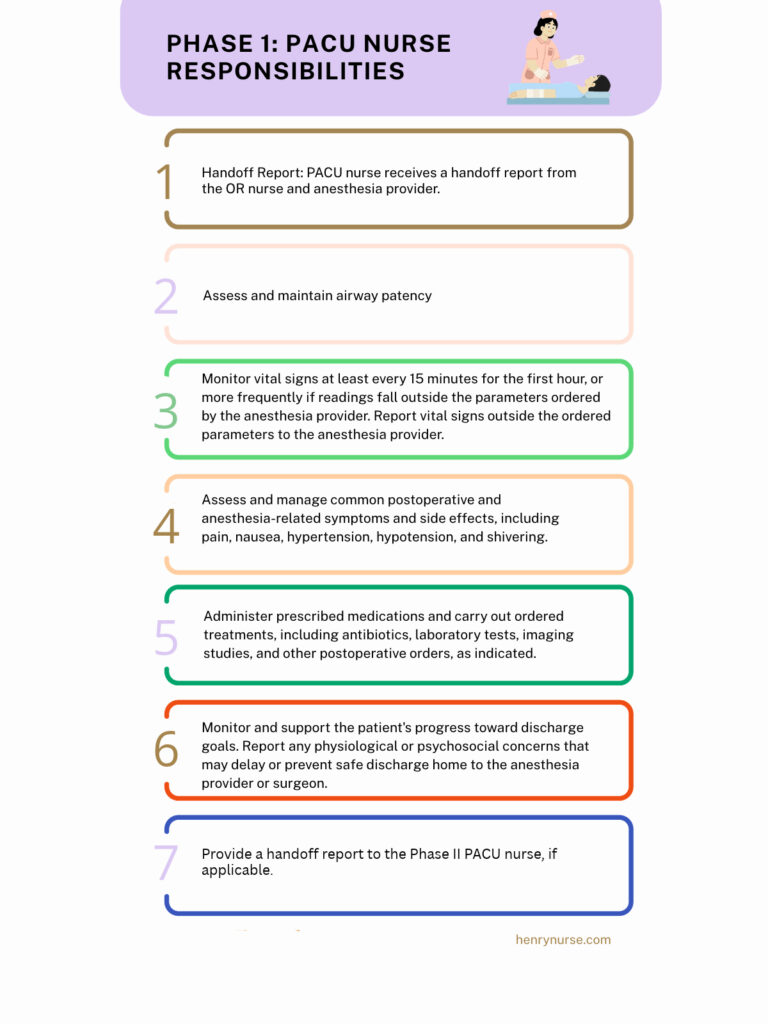
As a PACU nurse working in Phase I recovery, these are some of the responsibilities I typically perform:
- Monitor vital signs frequently, often every 15 minutes or more frequently depending on the patient’s condition and facility policy.
- Assess and maintain airway patency, ensuring the patient is breathing adequately.
- Monitor oxygenation and respiratory status, including the need for supplemental oxygen.
- Assess the patient’s level of consciousness as they emerge from anesthesia.
- Assess and manage postoperative pain, following prescribed orders.
- Monitor and manage nausea, vomiting, shivering, and other anesthesia related symptoms.
- Assess the surgical site for bleeding or other unusual findings.
- Recognize changes in patient condition that may require intervention or notification of the anesthesia provider.
What Is Phase II PACU?
Once patients in Phase I begin meeting the recovery criteria established by their facility, they can gradually transition into Phase II recovery.
The transition will look different in every PACU, and each facility will have its own specific criteria for when a patient is ready to progress.
But generally, patients transitioning into Phase II should demonstrate:
- Stable vital signs, within an acceptable range or near their baseline.
- Pain that is relieved or at least tolerable.
- Other postoperative symptoms, such as nausea and dizziness, that are controlled or manageable.
- Adequate recovery from anesthesia, including an appropriate level of consciousness.
- No concerning signs of active bleeding or other complications.
- Additional procedure specific requirements, such as tolerating oral fluids, voiding, or completing ordered laboratory tests when indicated.
Simply put, Phase II means the patient has progressed enough in their recovery that they generally no longer require the same intensity of monitoring as in Phase I.
And here’s another important point: Phase II is commonly focused on preparing patients for discharge home, particularly in ambulatory surgery settings.
What Does a Phase II PACU Nurse Do?
As a PACU nurse assigned to Phase II recovery, these are some of the responsibilities I typically perform:
- Continue monitoring vital signs, although usually less frequently than in Phase I. Depending on facility policy and patient condition, this may include assessments upon arrival, around medication administration, and before discharge.
- Ensure postoperative symptoms are manageable or tolerable, including pain, nausea, and dizziness.
- Confirm that ordered postoperative medications and treatments have been completed. Sometimes an IV antibiotic needs to be administered before discharge.
- Assess the surgical incision for bleeding or other unusual findings, and review wound and incision care with the patient and family or authorized representative.
- Assess patient mobility and ability to ambulate safely, independently or with assistance as appropriate, especially when preparing to go home.
- Check that ordered laboratory tests or imaging studies have been completed and reviewed as required, such as postoperative X rays for certain orthopedic procedures.
- Verify that prescribed discharge medications are available, including addressing any pharmacy issues before the patient leaves.
- Provide discharge instructions and ensure patient and caregiver understanding, allowing time for questions and clarification.
One thing I’ve learned is that Phase II nursing involves much more than simply waiting for patients to go home. There’s actually quite a bit of coordination involved!
Phase I vs Phase II PACU: Key Differences
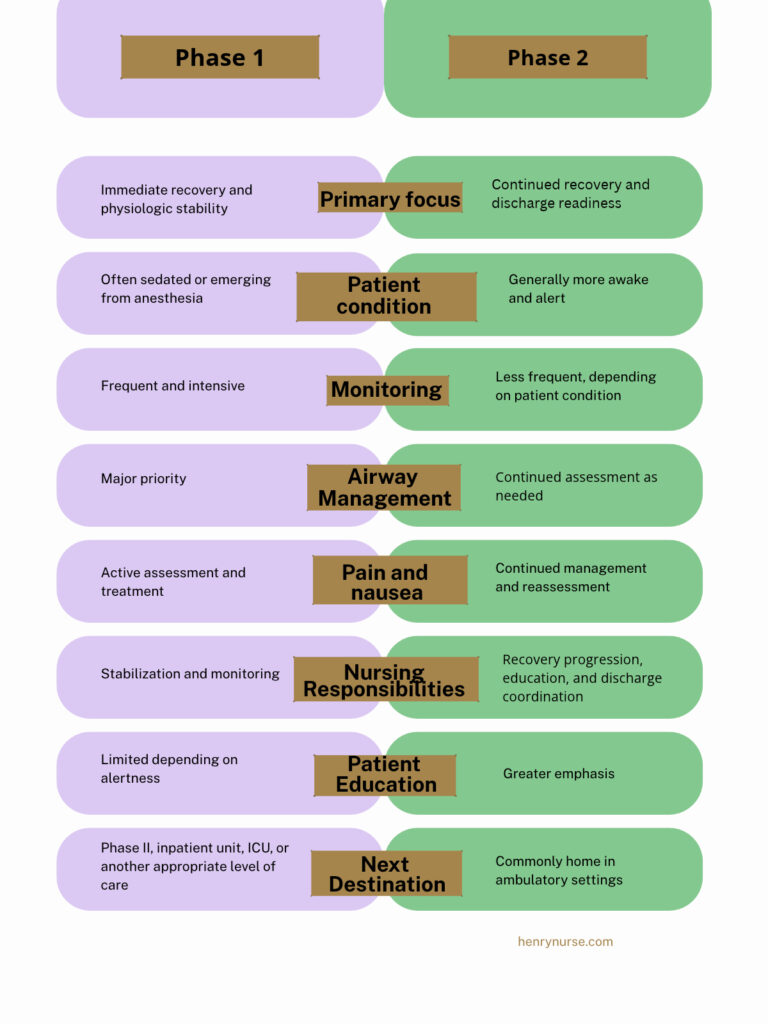
Is Phase I PACU Harder Than Phase II?
I wouldn’t necessarily say that one is harder than the other. They’re simply two different phases of PACU nursing that require somewhat different skills.
Phase I isn’t necessarily harder. It just involves closer and more frequent monitoring of the patient’s physiologic condition.
You might need to administer more medications or perform more frequent assessments, but honestly, most of the time, many of my Phase I patients are simply sleepy from anesthesia. They might need a little pain medication or something for nausea while they gradually wake up.
And remember, here in California, where I work, Phase I PACU nurses typically care for no more than two patients at a time, consistent with applicable staffing requirements.
Your primary focus is on your patient’s immediate physiologic needs and recovery from anesthesia.
Meanwhile, working as a Phase II PACU nurse is a different experience.
Your patient is usually awake and more alert, but you still need to attend to physiologic needs such as pain, nausea, and dizziness.
At the same time, you’re navigating the entire discharge process, which can involve:
- Providing discharge education, which can sometimes be quite lengthy.
- Ensuring the patient can safely go home.
- Addressing pharmacy issues, if there are any.
- Communicating with the patient and family.
- Coordinating with the surgeon, especially when patients or families have additional questions or concerns.
- Managing several patients simultaneously, sometimes up to four patients at a time in my work setting.
Personally, I prefer Phase I PACU because I can focus on attending to my patient’s immediate physiologic needs while fully practicing my clinical skills as a PACU nurse.
Of course, there are days when a Phase I patient requires a whole lot of those skills, including your critical care nursing skills!
But one of the good things about where I work is that we rotate between Phase I and Phase II assignments.
And honestly, there are days when I actually enjoy working as a Phase II nurse.
For one, I get to talk to my patients more because they’re awake and alert. I’m also able to advocate for them when they need something that could help improve their recovery at home.
And I actually get to see them go home!
There’s something satisfying about seeing your patient recover, giving them their discharge instructions, and wishing them well as they continue recovering at home.
Do All PACU’s Have Separate Phase I and Phase II Areas?
No, not necessarily.
But where I currently work, we do!
Some hospital PACUs have dedicated Phase II recovery areas, while others manage both phases in the same recovery space.
And to be clear, Phase I and Phase II refer to the patient’s physiologic stage of recovery, not necessarily a physical location within the PACU.
In my current inpatient PACU, we have two separate recovery areas. Actually, the Phase II unit is just in the next room!
Once our patients meet the required criteria to transition from Phase I, we transfer them to the Phase II area and give a handoff report to the nurse who will continue caring for them.
However, sometimes, particularly in the afternoon when staffing is limited, our charge nurse may decide to keep patients in the same PACU bay with the same nurse throughout both phases.
And to further illustrate why Phase I and Phase II aren’t necessarily physical locations, let me share my experience working in an ambulatory surgery center.
Most ASCs are relatively small, standalone surgical facilities, and they may not have enough space for a completely separate Phase II unit.
In the ASC where I worked, transitioning from Phase I to Phase II could simply mean documenting the transition time in the patient’s electronic health record, while the patient remained in the same recovery bay.
So again, think of Phase I and Phase II as stages of recovery rather than two separate rooms.
Read more about the difference between:
ASC Nurse vs Inpatient PACU Nurse: What’s the Difference?
When Does a Patient Move From Phase I to Phase II?
Most surgical facilities have their own criteria for determining when a patient is ready to transition from Phase I to Phase II.
Some surgical procedures or surgeons may also have additional requirements.
But generally, the following are important considerations:
- Airway safety: The patient can maintain their airway and breathe adequately, with oxygen requirements appropriate for their condition.
- Hemodynamic stability: Vital signs are stable and within acceptable parameters or near the patient’s baseline.
- Level of consciousness: The patient is sufficiently awake and alert for the next phase of recovery.
- Pain and symptom management: Pain, nausea, and other postoperative symptoms are adequately controlled.
- Recovery scoring: The patient meets the facility’s required recovery score or other established criteria.
These are the general considerations, but certain procedures or surgeons may require additional assessments, laboratory results, or imaging before the patient can transition.
And remember, meeting Phase II criteria is not necessarily the same as meeting the criteria for discharge home.
Phase I vs Phase II in an Ambulatory Surgery Center
As I mentioned earlier, Phase I and Phase II recovery in an ambulatory surgery center can look quite different from recovery in an inpatient PACU.
Some of the reasons include:
- More fast track cases, including shorter or less complex procedures that may only involve local anesthesia, minimal sedation, or monitored anesthesia care.
- Faster patient turnover, since most ASC patients are expected to go home the same day.
- Limited physical space, meaning there may not be a dedicated Phase II recovery unit.
In my experience working in an ASC, many patients were able to move quickly into Phase II recovery, particularly those who received lighter levels of anesthesia or sedation and met the appropriate criteria.
Of course, not every ASC patient bypasses Phase I.
Some patients still receive general anesthesia and require closer monitoring immediately after surgery.
And sometimes, the actual transition from Phase I to Phase II is simply a matter of documenting the recovery phase change in the electronic health record, without physically moving the patient.
This is one of the interesting differences I’ve noticed between working in an ASC and an inpatient PACU.
What Should Nurses Know Before Working in Phase I or Phase II PACU?
As a Phase I PACU nurse, you should be knowledgeable and competent in:
- Airway assessment and management
- Vital signs monitoring, including recognizing normal findings versus changes that require intervention or notification of anesthesia
- Pain management and treatment of other postoperative or anesthesia related symptoms
- Understanding anesthesia recovery
- Recognizing postoperative complications
Meanwhile, Phase II PACU nursing requires knowledge and competence in:
- General postoperative assessment
- Pain management and management of other postoperative symptoms
- Assessing discharge readiness
- Effective communication with patients, family members, authorized representatives, and surgeons
- Coordination of care involving pharmacies, surgeons, home health services, or transportation services when needed
- Providing clear and understandable discharge instructions and education
So, if you’re reading this because you’re considering becoming a PACU nurse, keep in mind that understanding Phase I and Phase II recovery is just one piece of the PACU nursing puzzle.
There’s still so much more to learn!
Like how to receive a patient from the OR, how to get an effective anesthesia report, which assessments and symptoms to prioritize, how to give a proper handoff, and how to determine whether a patient is ready and safe to go home.
But don’t let that overwhelm you. These are all skills you’ll gradually develop as you gain experience in PACU nursing.
Frequently Asked Questions: Phase I and Phase II PACU Nursing
What is the difference between Phase I and Phase II PACU?
In Phase I PACU, the nurse focuses primarily on assessing, monitoring, and managing the patient’s immediate physiologic needs and stability following anesthesia.
Meanwhile, in Phase II PACU, many of those same nursing responsibilities continue, but the patient is generally more stable and closer to discharge.
An important responsibility of the Phase II PACU nurse is assessing discharge readiness and providing effective discharge education.
What does a Phase I PACU nurse do?
A Phase I PACU nurse is responsible for maintaining patient airway safety, monitoring vital signs, assessing and treating pain, and managing other postoperative and anesthesia related symptoms.
The nurse also monitors for complications and intervenes when necessary.
What does a Phase II PACU nurse do?
A Phase II PACU nurse continues to monitor the patient’s condition, although vital signs are generally assessed less frequently than in Phase I.
The nurse also assesses discharge readiness, ensures postoperative symptoms are adequately managed, and provides clear, understandable discharge instructions to the patient and caregiver.
Can a PACU nurse work in both Phase I and Phase II?
Yes!
As a PACU nurse, I personally work in both Phase I and Phase II recovery.
I actually think it’s good practice to learn and become competent in both phases because each one involves different nursing responsibilities and skills.
Does every surgical patient go through Phase I PACU?
No.
Some patients who undergo fast track procedures or receive certain types of anesthesia or sedation may be eligible to bypass traditional Phase I recovery, depending on their condition and the facility’s established criteria.
How long does Phase I PACU last?
It depends on several factors, including:
- The patient, including age, comorbidities, and previous reactions to anesthesia
- The type of surgical procedure
- The type of anesthesia administered
- How quickly the patient recovers from anesthesia
- The presence of postoperative complications or symptoms
In my experience, Phase I recovery often lasts approximately one to two hours, although some patients recover faster while others require much longer monitoring.
What happens after Phase I PACU?
After meeting the appropriate recovery criteria, patients may be transferred to a dedicated Phase II recovery area and handed off to a Phase II nurse.
During Phase II, vital signs are generally monitored less frequently, and the nurse may encourage the patient to ambulate, use the restroom, or begin other activities as appropriate.
The Phase II nurse also focuses on discharge readiness, patient education, and preparing the patient and caregiver for a safe transition home.
However, not every patient goes to Phase II. Some patients are transferred directly to an inpatient unit or another appropriate level of care.
Is Phase II PACU the same as same day surgery?
No.
Phase II PACU refers to a stage of post anesthesia recovery, not necessarily the physical location of the patient.
Patients undergoing same day surgery may still require Phase I recovery, especially if they receive general anesthesia.
However, many procedures performed in ambulatory surgery centers are suitable for fast track recovery, particularly those involving local anesthesia or lighter levels of sedation.
When patients meet the appropriate criteria, they may bypass traditional Phase I recovery and proceed directly to Phase II.
Conclusion: Phase I and Phase II Are Different Parts of the Same Recovery Process
Just remember, Phase I and Phase II are not necessarily physical locations in PACU. Instead, they represent different stages along the patient’s recovery journey following surgery and anesthesia.
In Phase I, the focus is on the patient’s immediate safety and physiologic stability as they emerge from anesthesia. Particular attention is given to airway management, hemodynamic stability, and managing postoperative and anesthesia related symptoms.
Meanwhile, Phase II still involves monitoring and managing the patient’s physiologic needs, but with greater emphasis on discharge readiness, patient education, and coordinating a safe transition home.
As a PACU nurse for almost eight years, I’ve worked in environments where Phase I and Phase II are clearly separated, and I’ve also worked in PACUs where both phases happen in essentially the same place.
And that’s one thing I love about PACU nursing. Even within the same specialty, the workflow and nursing responsibilities can look quite different depending on where you work.
Are you interested in working as a PACU nurse?
Read more of my articles about PACU nursing:
Sources:
https://link.springer.com/chapter/10.1007/978-3-032-16811-5_18