
When is a patient truly ready to leave PACU? As a PACU nurse, I explain the essential discharge criteria, recovery scoring systems, and why clinical judgment matters just as much as meeting a discharge score.

This article is intended solely for informational and educational purposes. It does not constitute medical advice.
As PACU nurses, we are the clinical eyes in the recovery room. We are responsible for monitoring our patients, interpreting their recovery progress, and using established clinical assessment tools to help determine when they are ready for a safe discharge from PACU.
With the help of standardized, evidence based discharge assessment tools, we can better determine when a patient may be ready to leave recovery.
However, there is no single discharge timeframe that applies to every patient. Several factors can influence recovery time, including the type of surgical procedure, anesthesia used, and the patient’s overall condition.
And even with these standardized assessment tools, unfortunately, not every patient’s recovery is straightforward.
Some patients may develop postoperative concerns requiring further assessment, additional interventions, or simply more time in PACU.
What Are the PACU Discharge Criteria?
From my research, there doesn’t appear to be one universal list of PACU discharge requirements used by every healthcare facility.
Instead, each facility establishes its own discharge criteria and protocols.
However, most same day or ambulatory surgery centers generally include the following in their PACU discharge checklist:
- Stable vital signs and hemodynamic status
- Adequate respiratory function and oxygenation
- Appropriate level of consciousness
- Adequately controlled pain and postoperative nausea and vomiting
- No concerning surgical bleeding or immediate postoperative complications
- Meeting the facility’s established discharge criteria
Once again, the specific post anesthesia recovery assessments may vary between facilities, but these are generally among the most important considerations when determining discharge readiness.
What Score Is Used for PACU Discharge?
Most PACU settings use a standardized discharge scoring tool to help assess whether a patient is ready to leave the recovery room.
Some commonly used PACU discharge scoring systems include:
- Modified Aldrete Score
- Post Anesthetic Discharge Scoring System (PADSS)
- Facility specific scoring systems.
Some PACU settings even establish their own PASS scoring systems, which is what I personally use at work.
I wrote another article explaining this in more detail:
PASS Score Explained: A Practical Guide for PACU Nurses
But here’s something I want to emphasize:
A standardized discharge score is only one piece of the puzzle when determining whether a patient is safe to leave PACU.
A patient can meet the required PACU discharge score and still not be quite ready to go home. That’s why I never rely on the numbers alone.
A 2024 systematic review titled “Systems and Criteria for Patient Evaluation and Discharge in the Post-Anesthesia Care Unit: A Systematic Review” examined the advantages and limitations of various PACU discharge scoring systems.
The review highlights the importance of evaluating multiple clinical parameters and the limitations of relying solely on numerical scores to determine discharge readiness.
While these scoring systems are useful tools, they should complement, rather than replace, a comprehensive nursing assessment and clinical judgment.
For example, the PASS scoring system I use at work helps assess a patient’s recovery, but it doesn’t necessarily address every important postoperative concern.
It may not specifically account for:
- Bleeding from the surgical incision
- Procedure specific requirements, such as voiding before discharge
- Other clinical concerns that an experienced PACU nurse may recognize during recovery
Sometimes, even when a patient meets the required discharge score, there are other things you notice as a PACU nurse, using your clinical assessment skills and nursing intuition, that tell you the patient is not quite ready for a safe discharge.
And that’s exactly why a passing score doesn’t automatically mean a patient is ready to go home.
Phase I vs. Phase II PACU Discharge Criteria
I’ve discussed Phase I vs. Phase II PACU recovery in more detail in another article:
Phase I vs Phase II PACU: What’s the Difference?
Each phase has its own recovery goals and criteria that help PACU nurses determine when a patient can safely progress to the next stage of recovery.
Phase I and Phase II are not discharge scoring systems themselves. Instead, they describe different stages of post anesthesia recovery.
Here’s a quick comparison:
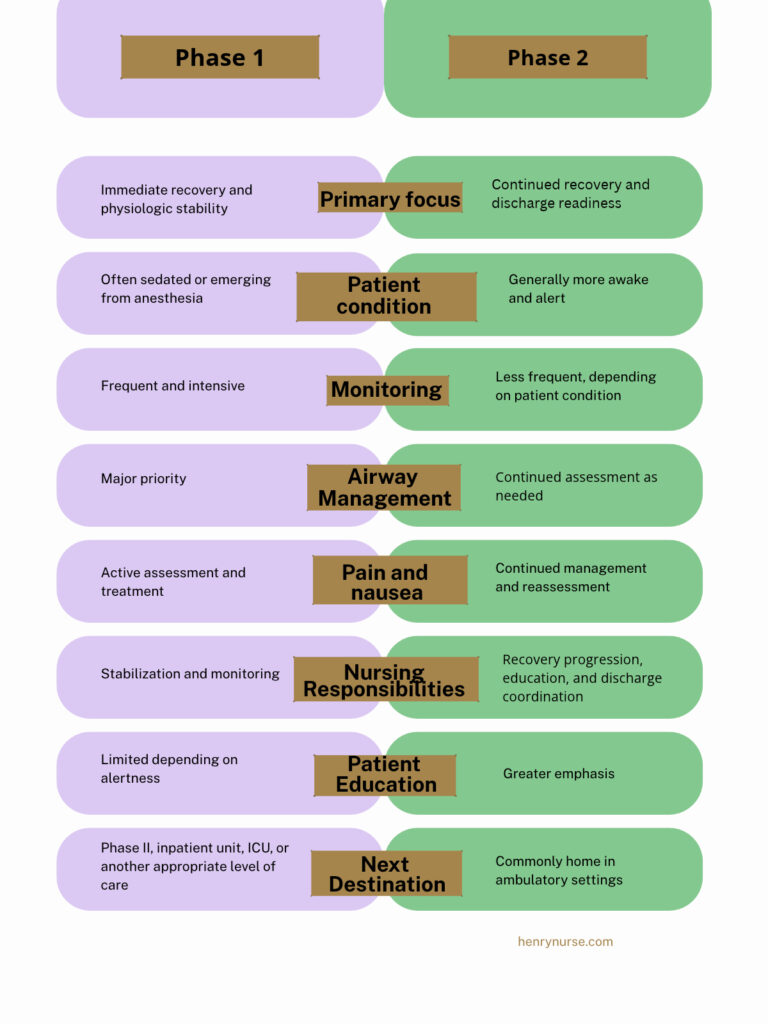
Two important things to remember:
First, some ambulatory surgery patients may bypass Phase I recovery, depending on the procedure, anesthesia used, and facility protocols.
For example, certain cataract surgeries performed under local anesthesia, such as numbing eye drops, may not require the same Phase I recovery process as procedures performed under general anesthesia.
Second, patients requiring inpatient admission may follow a different recovery and transfer process.
Some patients may continue aspects of their postoperative recovery in an appropriately monitored inpatient unit, depending on their clinical condition and the facility’s established protocols.
So basically, discharging a patient home is different from transferring a patient to another level of care.
A patient going to a regular medical surgical unit may have different transfer requirements from someone requiring a stepdown unit or ICU.
You may also find this helpful:
What Happens When a PACU Patient Needs Hospital Admission Instead of Discharge?
What Can Delay Discharge From PACU?
With the wide variety of surgical procedures, different types of anesthesia, and patients with different medical histories and comorbidities, it’s not surprising that PACU recovery times can vary significantly.
Some common reasons for delayed PACU discharge include:
- Prolonged recovery from anesthesia, which may occur after certain lengthy or complex procedures
- Persistent hemodynamic instability, such as hypotension or hypertension
- New onset cardiac arrhythmias
- Uncontrolled postoperative pain, nausea, or vomiting
- A patient expressing that they do not feel ready to go home, which may warrant further assessment
- Delays in obtaining postoperative medications from the pharmacy
There are also a few discharge requirements that may vary depending on the procedure, anesthesia, and facility protocols.
Voiding before discharge
Not every patient needs to urinate before leaving PACU. However, certain urological, gynecological, or other procedures may require confirmation of adequate urinary function before discharge.
Eating or drinking before discharge
Not every patient needs to tolerate oral intake before going home. In some cases, encouraging patients to eat or drink unnecessarily may worsen postoperative nausea and delay discharge.
Having an escort or driver home
I personally think this is an important discharge consideration, especially for patients who have received sedation or general anesthesia.
However, I’ve worked in surgical settings where patients were permitted to use rideshare transportation under certain circumstances.
Whether this is acceptable depends on the anesthesia provided, facility policy, and discharge arrangements. A rideshare driver alone should not automatically be considered an appropriate responsible adult escort.
Sometimes, PACU/Recovery Room Patients Just Need More Time
One thing I’ve learned from working in PACU is that no two patients recover exactly the same way.
Patients can undergo the same surgical procedure, have the same surgeon, and receive similar anesthesia, yet have completely different recovery experiences.
Take hysterectomies, for example.
These can be physically painful procedures, but for some women, they may also carry a significant emotional impact.
In my personal opinion, procedures such as hysterectomies and certain cancer related surgeries can be emotionally difficult because patients may be coping with the loss of a part of their body, changes in their sense of womanhood, or the circumstances that led to surgery.
Of course, every woman’s experience is different.
And while we have established recovery protocols and expected discharge timeframes, I try to give these patients a little extra grace when they need it.
Even when the charge nurse is already giving me the evil eye, wondering why my patient is still in PACU!
As much as I reasonably can, while following our discharge protocols and considering the patient’s clinical condition, I allow patients additional time to rest and recover.
Because sometimes, a patient may meet the clinical discharge criteria but still need reassurance, emotional support, or further assessment before going home.
And I think that’s an important part of being a PACU nurse, too.
Sometimes patients need a little more time to recover, physically or emotionally. Even when the charge nurse is already giving me the evil eye because my patient is still in PACU!
Final Thoughts From a PACU Nurse
I like to think of PACU discharge as putting together a puzzle.
There are several important pieces that need to fit together before the PACU nurse and anesthesia provider can see the complete picture of whether a patient is ready for a safe discharge or transfer.
These pieces include:
- PACU discharge scoring systems, such as PASS or Modified Aldrete
- The patient’s stage of recovery, whether Phase I or Phase II
- Your facility’s established PACU discharge criteria
- The surgeon’s specific postoperative discharge requirements
- Your clinical assessment and judgment as a PACU nurse
And perhaps most importantly, recognizing when a patient needs further assessment, even when the numbers and scoring systems suggest they are ready.
Because ultimately, safe PACU discharge is about more than meeting a score or following a timeline.
It’s about assessing the whole patient.
Safe PACU discharge is about more than meeting a score or following a timeline. It’s about putting together all the pieces and assessing the whole patient.
Frequently Asked Questions About PACU Discharge
What Is the Minimum Modified Aldrete Score for PACU Discharge?
I don’t personally use the Modified Aldrete scoring system where I work.
However, according to the article “Post-Anesthesia Recovery: A Comprehensive Review of Sampe, Modified Aldrete, and White Scoring Systems”, a score of 9 to 10 generally indicates recovery readiness, while a score below 9 typically suggests that further monitoring or management may be needed.
Of course, as I’ve mentioned throughout this article, there are limitations to PACU discharge scoring systems.
Always refer to your facility’s established discharge protocols, perform your own comprehensive nursing assessment, and consult the anesthesia provider when needed.
Can a Patient Be Discharged From PACU With Oxygen?
Yes, depending on the patient’s baseline oxygen requirements, clinical condition, discharge destination, and facility protocols.
For example, some patients with chronic respiratory conditions, such as COPD, may already use supplemental oxygen at home.
For otherwise healthy ambulatory surgery patients, we generally want to see adequate oxygenation without supplemental oxygen before discharge home, unless otherwise ordered or permitted by the applicable protocol.
Some anesthesia discharge orders specify an oxygen saturation threshold, but there is no single SpO₂ cutoff appropriate for every patient.
It’s important to consider the patient’s baseline oxygenation, respiratory status, and the anesthesia provider’s discharge instructions.
Who Determines Whether a Patient Is Ready for PACU Discharge?
The anesthesia provider has an important role in determining discharge readiness, while the PACU nurse performs ongoing recovery assessments and helps determine whether the patient meets established discharge criteria.
Depending on the facility, discharge may be authorized through specific practitioner orders or approved discharge protocols.
As PACU nurses, we contribute through:
- Ongoing patient monitoring and assessment
- Standardized recovery scoring systems
- Assessment of Phase I and Phase II recovery
- Recognition of postoperative complications
- Clinical judgment and communication with the anesthesia provider
Ultimately, PACU discharge is a collaborative process centered on patient safety.